
The Communication Breakdown: A Deep Dive

What's actually happening in your teen's brain when they shut down — and why the way most of us were taught to communicate makes it worse.

ANCHOR POINT

Calm in the Storm

ISSUE #2 | THE COMMUNICATION BREAKDOWN

FOR THE ADULTS WHO HAVEN'T GIVEN UP AnchorPointCalmintheStormapp.com

FROM THE ANCHOR DESK

You Came Back. That Tells Us Everything.

Hey —

You're here. That matters.

You didn't read Issue #1 and move on. You stayed. You're still asking questions. You're still trying to figure this out.

That's not nothing. That's actually everything.

Last issue, we named the three things nobody talks about. We promised to go deeper on the first one — the communication breakdown. So here we are.

This issue is about what's happening when your teenager shuts down, blows up, or looks right through you. It's about why the things most of us were taught to do — the talks, the questions, the "we need to talk" moments — often make things worse. It's also about three things you can say that actually work.

We're also doing something new this issue. You're going to get to know us a little. Because you shouldn't take advice from strangers. You deserve to know who's in your corner and why.

Let's get into it.

Holding the line with you,

Kim & Trudy Founders, Anchor Point

THE DEEP DIVE

What's Actually Happening When They Shut Down

Here's the thing nobody tells you.

When your teenager shuts down or blows up — it's not a choice. It's not attitude. It's not them deciding to make your life hard.

Their brain is doing something it was built to do.

Think about the last time you were really overwhelmed. Not just stressed — actually overwhelmed. Maybe you were running on no sleep. Maybe three things went wrong at once. Maybe someone said something that hit you in exactly the wrong way.

Remember how hard it was to think clearly? To find the right words? To stay calm when you really wanted to lose it?

That's what's happening in your teenager's head. A lot. And their brain is still being built — which means they have even less control over it than you do.

When they feel threatened — even by a question that sounds totally normal to you — something switches. Their body goes into protect mode. Their heart speeds up. Their thinking shuts off. The part of their brain that could say "I hear you, I'm just stressed" goes quiet.

What comes out instead is a slammed door. A one-word answer. Silence.

They're not choosing to be unreachable. They're just not in control right now.

The eye roll isn't attitude. It's a nervous system doing its job.

We're going to introduce you to the Anchor Point Brain Team over the next few issues. It's a set of characters we use to explain what's happening inside the brain. Each one has a specific job. When they're all working together, things go smoothly. When one of them takes over — especially the one we call SCOUT, the brain's alarm system — everything shuts down.
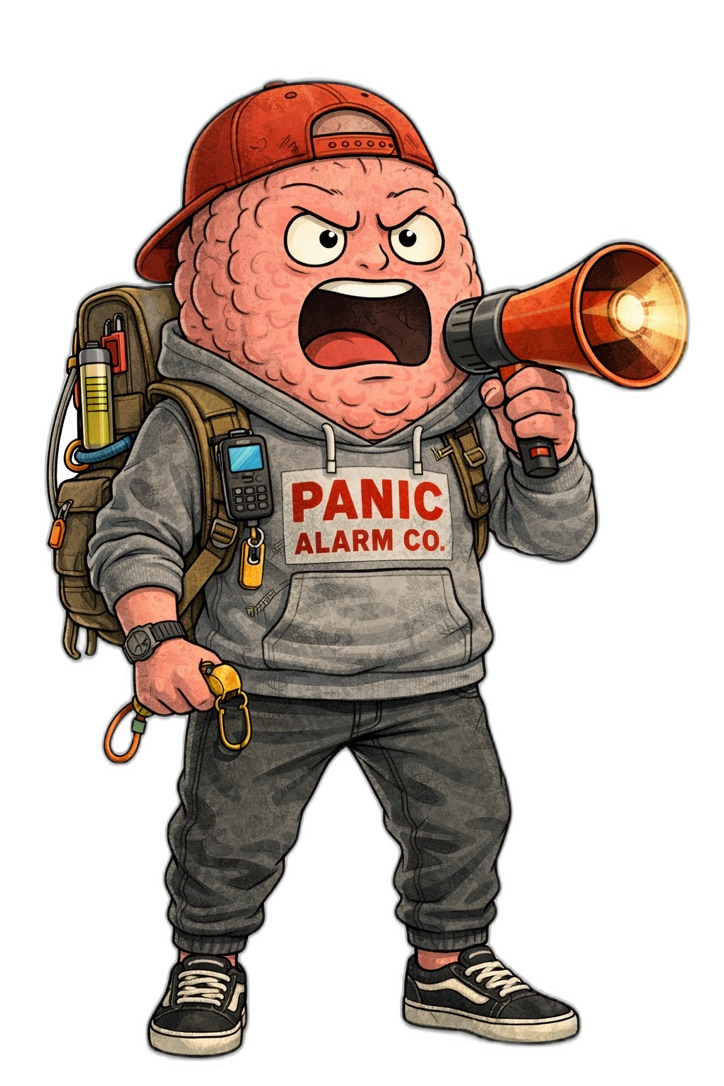
SCOUT — Brain Team character
Brain Team

SCOUT

Your brain's alarm system.

SCOUT's job is to keep you safe. When something feels wrong — or even just uncertain — SCOUT fires first and asks questions later. That's not a flaw. That's survival. But sometimes SCOUT goes off when there's no real danger. That's when things get hard.

More on SCOUT next issue. For now, just know this one thing:

When your teenager shuts down or blows up, SCOUT is running the show. SCOUT doesn't respond to lectures. It doesn't respond to "we need to talk." SCOUT only responds to one thing.

Safety.

That's the whole game.

WHY WHAT YOU WERE TAUGHT BACKFIRES

Most of us learned to talk to teenagers the same way our parents talked to us. Our parents were doing the best they could with what they had.

But some of the moves we learned — the ones that feel like love, that feel like the right thing to do — actually make things worse. Not because we're bad at this. Because we were handed the wrong tools.

Here are the three biggest ones.

The Lecture.

You have something important to say. You've thought it through. You sit down and explain — clearly, calmly — what the problem is and what needs to change. It makes complete sense to you.

They stare at the wall.

Here's why. When a teenager's system is already fired up, more words don't help. They make it worse. The more you talk, the more their brain reads it as a threat. The more shut down they get. You're not wrong to want to say what you're saying. The timing is just working against you.

The Interrogation.

"How was your day?" "Why did you do that?" "What were you thinking?"

These feel like connection. To a teenager who's already on edge, they feel like an inquisition.

Questions that start with "why" are the hardest. They ask for a reason. And a brain in protect mode can't give you a reason. It can only give you "I don't know." Or a shrug. Or nothing at all.

The "We Need to Talk."

Four words. That's all it takes to put a teenager's whole system on high alert before the conversation even starts. They spend the next ten minutes bracing for whatever's coming. By the time you sit down, they're already shut off.

None of this means you did something wrong.

It means you were using the wrong map.

You weren't failing at communication. You just needed a better map.

THE ANCHOR TOOL

Three Things You Can Say That Don't Get an Eye Roll

Every issue, we give you one tool. This issue you get three — because this topic earned it.

These aren't magic words. They're starting points. They work because they're low pressure. They don't ask for a reason. They don't announce a problem. They just open a door.

#1: "What's been the best part of your day so far?"

Not "how was your day." Not "did anything good happen."

What's been the best part.

That small change does something. It assumes something good happened. It shifts the whole feel of the question. It doesn't ask them to explain anything — just to remember something.

One more tip: try it side by side. In the car. At the dinner table. While you're both doing something else. Looking at each other puts more pressure on the moment, but looking at the same thing takes it off.

#2: "I've been thinking about something — can I run it by you?"

This is the "we need to talk" replacement.

Instead of announcing a problem, you're asking for their help. You're saying: I need your input. That's a completely different message. Teenagers want to matter. When you ask for their perspective instead of telling them what's wrong, you're speaking their language.

It also gives them a second to get ready. Which means they're less likely to shut down before you even start.

#3: "That sounds really hard. What do you need right now?"

This one is for the moments when they're already upset. When the door is about to slam or the tears are already there.

Most of us want to fix it. Explain it. Make it better fast. The first thing a fired-up nervous system needs isn't a solution. It needs to feel heard.

"That sounds really hard" does that. It doesn't mean you agree. It doesn't mean you're giving in. It just means: I see you. I'm not running from this.

"What do you need right now" hands them some control. Which is exactly what a teenager's brain is looking for.

You might not get a clean answer. They might say "I don't know." That's okay. The question still says something they need to hear: that you're not going to make this moment worse.

Connection before correction. Every single time.

MEET THE FOUNDERS

The People Behind Anchor Point

We said last issue we'd never ask you to take advice from strangers. So here's a little of who we are — and why we built this.

KIM LOCKMAN NYS Master Teacher | 25 Years in Education | Behavior Specialist

Kim was the kid in the back of the room.

Hyper. Funny. Could derail a lesson in under twelve seconds. Teachers sent her to other classrooms with notes — partly because she was "helpful," and partly because they needed a break.

For years, she heard two things on repeat: you're stupid — or — you're smart if you'd just sit down and apply yourself.

College changed everything. Kim found out she had AuDHD, Dyslexia, Dyscalculia, Auditory Processing Disorder, and Learning Disabilities in both reading and math. For the first time in her life, she learned how her brain actually worked.

That moment didn't just change her grades. It changed her whole story.

Then — plot twist — she became a teacher.

For 25 years, Kim has taught grades 5 through 12. She's been a department chair, an administrator, and a behavior specialist. She built her career on one promise: she would never become the kind of educator she hated as a kid. Not ever.

She became the person people called when things got too big and the room got shaky. Because she doesn't panic when things escalate. She gets grounded, gets curious, and helps people find their footing again.

She holds a New York State Master Teacher designation — one of the most competitive honors in education — along with advanced degrees in Special Education, Educational Administration, and Exercise Physiology. She's also a certified EMT and wilderness first responder, because she believes the body and the brain are part of the same conversation.

Kim's approach is direct, funny, and built for the worst days — not just the easy ones.

TRUDY BEICHT Mental Health Professional | Youth & Family Specialist

Trudy has been independent since she was five.

By thirteen, she was solving problems like an adult. She chased down a scholarship to a tuition-based high school, worked weekends to cover the rest, and became the first in her family to go to college. At eighteen, she moved out — no safety net, just determination and what she calls "a slightly alarming amount of grit."

For the past two decades, Trudy has worked in the mental health space — supporting kids with diagnoses, walking alongside families and educators, and problem-solving in real time when things get hard. She has served as a Care Coordinator, directed a youth bureau with a team of 50+ staff, and co-founded T.I.M.E. Consulting LLC, where she has worked with school and community programs across New York State. She holds a Master's degree in Educational Psychology.

But the deepest reason Trudy does this work didn't come from a degree. It came from love.

Being married to Kim — someone whose brain and nervous system move fast, feel big, and react strongly — has been one of her greatest teachers. She knows what it means to be the steady one. The person who holds the temperature of the room while also trying to stay kind, stay connected, and stay human.

She knows the invisible weight of that role. And she knows how much it matters to have even one grounded person in your corner when the storm gets loud.

That's part of why Anchor Point exists.

"You don't have to do this alone."

Together, Kim and Trudy bring over 40 years of combined experience in education, behavioral health, and direct support of families and youth. Kim brings the fire. Trudy brings the ground. Anchor Point is what happens when those two things meet.

Next issue, you'll get to know a little more about the framework they built — and the tools that came out of it.

REAL TALK

*Composite story based on real experiences. Names changed.

"My son is fifteen. For the past year, every conversation turned into a fight. I'd ask him something simple — 'how was practice?' — and he'd look at me like I'd asked him to solve a math problem in a foreign language.

I started dreading talking to him. Then I started dreading myself for dreading it.

What nobody told me was that I was doing everything right in my head and everything wrong in the room. I was asking 'why' questions. I was doing the face-to-face thing. I was having the 'we need to talk' conversation at 9 PM when we were both exhausted.

The first time I tried 'what's been the best part of your day?' he looked at me sideways, but he answered. We talked for eleven minutes. I counted."

— Anonymous, mother of a 15-year-old

Want to share your story? We'll never use your name unless you ask us to. Your story could be the thing another parent needs to hear tonight.

COMING UP IN ISSUE #3

"Nothing I Do Works" — A Deep Dive on Helplessness

We're going into Pain Point #2. Why the tools that used to work stopped working. What the difference is between discipline and connection. And one reframe that changes how you respond when you feel completely out of options.

We'll also go deeper on the Brain Team — and introduce you to the character that's quietly running the show in almost every hard moment you've had with your kid.

WANT MORE RIGHT NOW?

The Anchor Point app gives you real-time, step-by-step guidance in the exact moment things escalate. Describe what's happening. Get expert-backed direction in about 30 seconds. Track what works so the next time is easier.

AnchorPointCalmintheStormapp.com

If you want to go deeper on the brain science behind everything in this issue, our ebook series breaks it all down in plain language. No textbooks. No jargon. Just the stuff that actually helps.

Share this with someone who needs it. Forward this email. They'll thank you.

THE ANCHOR LINE

"You are not failing because you don't have the answers. You are succeeding because you keep asking the questions."

ANCHOR POINT | Calm in the Storm AnchorPointCalmintheStormapp.com