
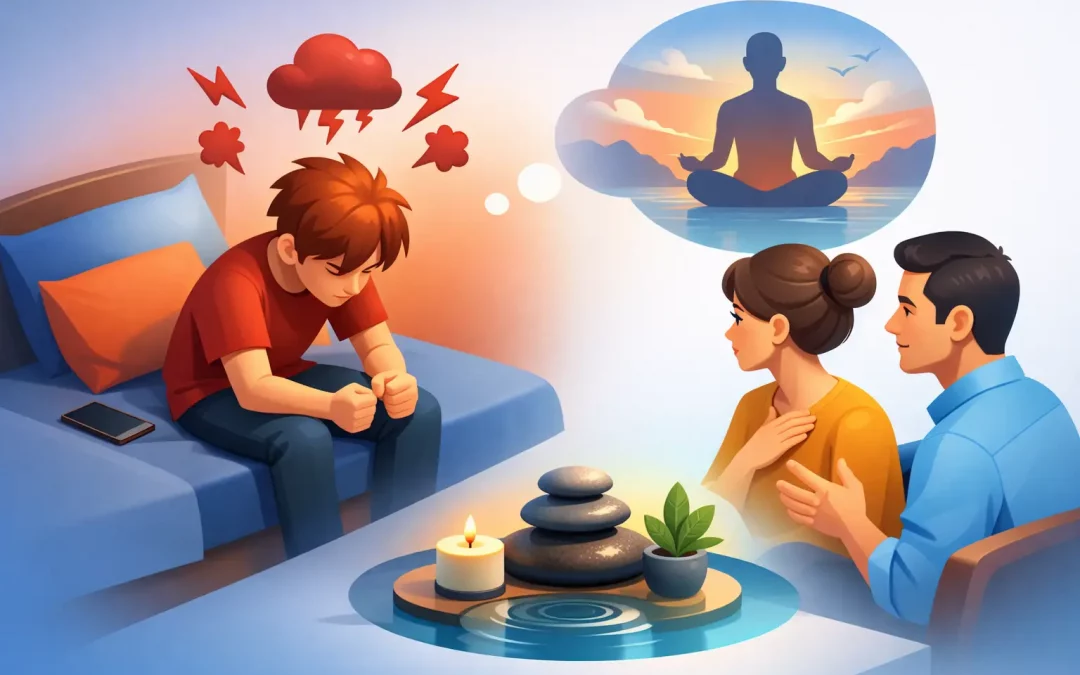
A slammed door can make the whole house tense in seconds. A sharp tone in class can throw off an entire morning. If you are looking for a teen anger support guide, you probably do not need theory right now. You need a way to stay steady, make sense of what is happening, and respond without making things worse.
That starts with one helpful shift. Anger is real, but anger is not the whole story. For many teens, angry behavior is the top layer of something deeper – stress, shame, fear, disappointment, sensory overload, social pressure, grief, or feeling trapped. That does not mean hurtful behavior is okay. It does mean that if we only react to the surface, we miss the need underneath.
What anger in teens is often telling you
Teen anger can look loud, but sometimes it shows up as cold silence, eye rolling, picking fights, refusing to talk, or being harsh with siblings and adults. The behavior may look oppositional. Underneath, the nervous system may be overloaded.
A teen who snaps over a small request may already be carrying a full day of stress. A teen who explodes when corrected may be hearing, deep down, “I am failing again.” A teen who gets aggressive when plans change may not be controlling. They may be flooded.
This is where adults often get pulled into a power struggle. We see disrespect and move quickly to control it. The teen feels more threatened, cornered, or misunderstood. The behavior rises. Nobody feels safe, and nobody feels heard.
A calmer read is more useful. Behavior is communication. Dysregulation is not defiance. When you respond to anger as a sign that your teen needs regulation before reasoning, you gain more influence, not less.
A teen anger support guide built around real moments
When anger spikes, most adults need something simple enough to use in real time. A helpful structure is Notice, Regulate, Respond, Repair. It gives you something solid to hold onto when the moment feels shaky.
Notice what is happening without rushing to judge it
Start by noticing the signs of escalation. This might be pacing, clenched fists, a louder voice, quick breathing, slammed objects, swearing, or shutting down after a hard interaction. Also notice your own body. If your chest is tight, your voice is rising, or you feel the urge to lecture, your system is reacting too.
This matters because your regulation sets the tone. You do not have to be perfectly calm. You do need to slow your own reaction enough to choose your next step on purpose.
Try simple language in your own mind first: “My teen is overwhelmed.” “This is a stress response.” “I do not have to solve everything in this minute.” Those quiet reminders can keep you from matching intensity with intensity.
Regulate before you try to reason
A dysregulated teen is not in a good place for learning, listening, or problem-solving. The same is true for adults. Regulation comes first.
That may mean lowering your voice, taking one step back, relaxing your shoulders, or pausing before you speak. It may mean choosing fewer words. A teen in a flooded state often cannot process a long explanation, even if your point is valid.
You can say, “I can see you are really upset.” “I am not going to argue with you right now.” “We can talk when this comes down.” If the teen is escalating toward unsafe behavior, focus on safety and space, not insight. Move other kids away. Remove objects if needed. Keep your body language non-threatening. Call for additional support when safety requires it.
This is the part many adults skip because it can feel like giving in. It is not. Regulation is not permission. It is the fastest route back to enough calm for limits to mean anything.
Respond with clear, steady boundaries
Once the heat comes down even a little, your response can be both kind and firm. The goal is not to win. The goal is to reduce harm and keep the relationship strong enough for accountability.
Try short statements: “I want to hear you. I will not stay in the room if things are being thrown.” “You can be angry. You cannot call me names.” “We are taking a break, and we will come back to this in 20 minutes.” Clear boundaries help teens feel the edge of the container without feeling attacked.
It also helps to avoid common traps. Long lectures usually add fuel. Asking too many questions in the peak of anger can feel like pressure. Matching sarcasm with sarcasm almost always backfires. Consequences decided in the hottest moment are often harsher than you mean and harder to carry out later.
Sometimes the most effective response is very small. A quiet, “Not like this. We will talk later,” can do more than a ten-minute speech.
Repair after the storm passes
Repair is where trust grows back and learning actually happens. This part is easy to miss, especially if everyone is exhausted, but it matters.
Repair does not mean pretending the incident was fine. It means returning to it when both of you are steadier. You might say, “Earlier was rough. I want to understand what was happening for you.” Then stay curious. Was there a trigger you missed? Did they feel embarrassed, cornered, or already maxed out? What helped them come down, even a little?
Then bring in accountability. “It makes sense that you were angry. It does not make it okay to punch the wall.” Both things can be true. Validation and limits belong together.
If your own response was not what you wanted, repair that too. “I raised my voice. That did not help. I am working on staying steadier.” Adults do not lose authority by owning their part. They build credibility.
When this teen anger support guide needs adjustment
Not all anger is the same. Some teens get loud and recover quickly. Others hold anger for hours. Some are explosive at home and tightly controlled at school. Others unravel after keeping it together all day. The pattern tells you something.
If anger is frequent, intense, or tied to certain settings, start looking for conditions around it. Hunger, lack of sleep, academic pressure, social conflict, trauma reminders, sensory overload, and feeling constantly corrected can all lower a teen’s capacity fast.
This is also where expectations matter. A teen with a history of trauma, ADHD, anxiety, depression, autism, learning struggles, or chronic stress may need more support, more repetition, and more co-regulation than adults expect. That is not lowering the bar. That is matching support to what is actually hard.
There are times when outside help is the right next step. If anger includes threats, property destruction, physical aggression, self-harm, running away, or a pattern that is making home or school feel unsafe, bring in added support. Needing more support is not failure. It is good judgment.
What helps in the hours before anger shows up
The best anger support often starts long before the outburst. A teen who feels constantly corrected will usually stay braced for the next conflict. A teen who has some predictability, some choice, and some connection has more room to recover when stress hits.
Look for small prevention moves. Give a heads-up before transitions. Save hard conversations for calmer windows. Offer choices where you can. Notice effort, not just mistakes. Build in decompression time after school. Keep requests clear and short when your teen is already running hot.
It also helps to talk about anger outside the moment. Ask, “How do you know you are getting close to losing it?” “What makes it worse?” “What helps, even a little?” Teens are more likely to use a plan they helped create.
For some families, that plan is as simple as a code word, a break option, and a shared agreement about what happens when voices rise. Simple plans are easier to use when stress is high.
If you support teens in a classroom, program, or helping role, the same principle holds. Private correction is usually better than public correction. Calm tone matters. So does preserving dignity. Many angry escalations are really shame escalations.
You are not trying to remove every hard feeling from a teen’s life. You are helping them move through hard feelings with less damage and more skill. That takes repetition. It takes steadiness. And yes, it takes adults having tools instead of shame.
At Anchor Point Calm in the Storm, we come back to this again and again: notice what is happening, regulate first, respond clearly, and repair the relationship. Progress often looks quiet. A shorter argument. A faster recovery. One less door slam. One more honest conversation after a hard moment.
If things have been tense lately, start smaller than your guilt says you should. Pick one phrase you can use. Pick one boundary you can hold calmly. Pick one moment to repair instead of rehash. Small steady changes are often what help a teen feel safe enough to do something different next time.

 English (United States)
  English (UK)