
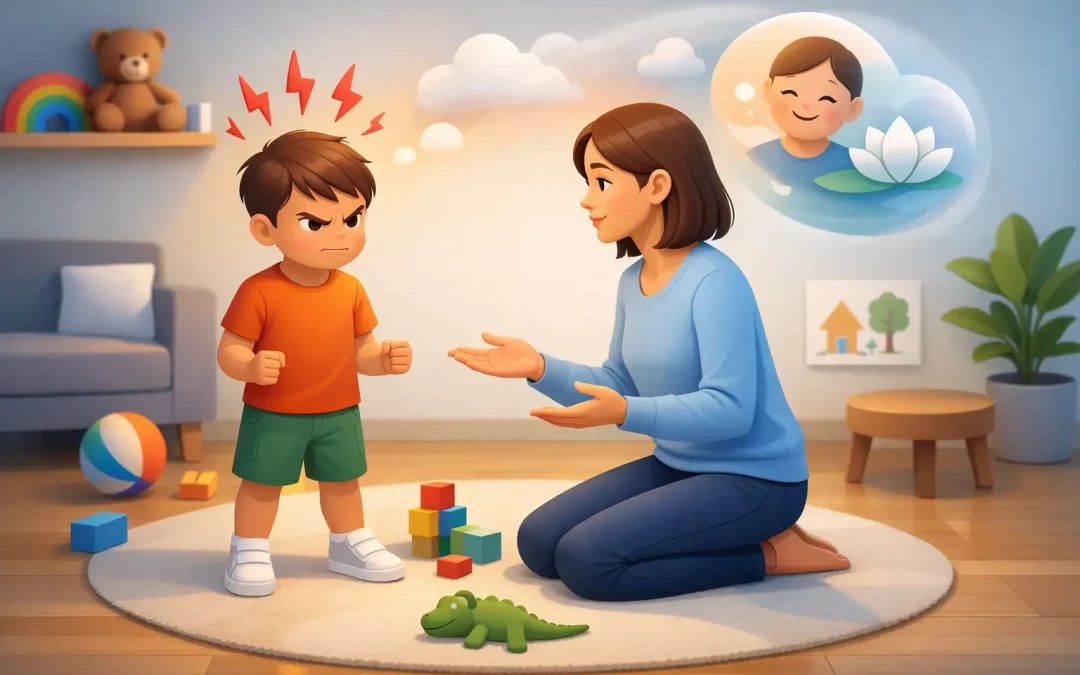
When a Child Gets Aggressive — What to Do Right Now A child is yelling, kicking the chair, trying to hit. Your body reacts before your mind can catch up. Your heart races. You want it to stop — now. If you are searching for how to respond to child aggression calmly, you are probably not looking for theory. You need something steady enough to use in a hard moment.
That is where a simple framework helps. When a child becomes aggressive, the goal is not to win, overpower, or teach a perfect lesson in the middle of chaos. The first goal is safety. The second is regulation. The lesson comes later — when the child can actually receive it.
Aggression can look scary, disrespectful, or deliberate from the outside. But very often it is a stress response. A child may be overwhelmed, cornered, ashamed, frustrated, or completely unable to do what is being asked in that moment. That does not make hitting or throwing okay. It does mean the behavior is telling you something important. Notice what is happening in you first Before you can help a child settle, you need a quick read on your own state. Are you angry? Startled? Embarrassed because someone is watching? Do you feel the urge to yell, grab, argue, or punish fast?
That inner surge matters. A stressed adult cannot reliably calm a stressed child. You do not need to feel perfectly peaceful — you just need enough steadiness to slow your reaction by a few seconds.
One breath, longer on the exhale. Unclench your jaw. Drop your shoulders. Plant your feet. A short phrase can help: This is hard — and I can stay steady. That brief pause is not doing nothing. It is active prevention. Reduce stimulation before you say a word When aggression starts, words often stop working. Safety and space come first.
Move breakable objects if you can do it safely. Give room instead of crowding. Lower your voice. Keep your face neutral or concerned — not glaring. If siblings or other kids are nearby, guide them away. If the child is younger, get lower and turn slightly sideways rather than standing over them. If the child is bigger or completely overwhelmed, more distance may help.
This is the part many adults skip — because they want immediate compliance. But a child who is past their limit usually hears demands as pressure. Pressure tends to increase aggression. Not reduce it. Use fewer words and a steadier tone Once safety is in motion, keep language short and clear. Long explanations, repeated questions, and lectures add fuel.
Try: “I won’t let you hit.” “You’re really upset — I’m going to help keep this safe.” “Take a step back.” “Put it down.” “I’m here. We’re getting safe first.”
They set a limit. They do not add shame. They do not debate the child’s feelings — and they do not excuse the behavior. They communicate: I am not against you. I am helping us through this.
If the child can still follow language, offer one simple choice. “You can sit on the couch or stand by the door.” “You can squeeze this pillow or stomp your feet.” Choices work best when both options are safe and neither feels like a trap. What calm actually looks like in a hard moment A lot of adults hear calm and think soft. Passive. Endlessly patient. That is not it.
Calm is clear. Calm is boundaried. Calm means your voice is steady enough that it does not add more threat to a child who already feels threatened.
Sometimes calm looks firm. If a child is trying to hurt someone, you may need to block, move people back, or call for support. Calm does not mean allowing aggression — it means responding with intention instead of panic or punishment.
There is a real balance here. If your focus is only on being gentle, you may under-respond and leave people unsafe. If your focus is only on stopping the behavior fast, you may over-respond and make things worse. The middle path is steady and clear — protect safety without adding fuel. What tends to make it worse The hardest part of these moments is that the most natural adult reactions often backfire.
Threats feel logical in the moment. So does arguing, correcting, or demanding an explanation. But asking “Why are you doing this?” rarely works when a child is completely overwhelmed — the thinking part of the brain is just not available. Public correction can increase shame — and shame tends to increase aggression.
Physical touch is complicated too. It can help in some cases and escalate in others — depending on the child, your relationship, and whether they experience touch as soothing or intrusive.
If you know a child gets more explosive when cornered, give more room. If a child tends to feel abandoned when adults step away, stay present but not close. Calm support is never one-size-fits-all. Once safety is there — look underneath When the child begins to settle, your job shifts. This is when curiosity matters more than control.
Aggression is usually the visible part of a deeper struggle. Maybe the demand felt impossible. Maybe there was a sudden transition. Maybe they were already carrying stress from school, hunger, or a hard social moment. Maybe they felt cornered — and flooded with shame.
This does not remove accountability. It gives you a more accurate map. If you only respond to the surface, you may keep fighting the same fire without ever addressing what keeps starting it.
A more useful question than “How do I stop this from ever happening again?” is: “What was this child unable to do in that moment — and what support was missing?” Repair comes after regulation Children need accountability. They also need a path back.
When the child is calm enough to think, keep the conversation simple. Name what happened without a pile-on. “You were really upset and you hit.” Add the limit. “I can’t let people get hurt.” Then move toward repair. “What needs to happen now?”
Depending on age and situation, that might mean checking on someone, cleaning something up, or writing a note. It might mean practicing a different way to ask for help.
This is also the right moment to teach one replacement skill — not ten. Practice saying “I need space.” Asking for a break. Squeezing something instead of hitting. One skill — small enough to actually use next time. How to stay steadier over time If aggression is happening regularly, better reactions in the moment are only part of the answer. Preparation matters just as much.
Look for patterns. Does it happen during transitions, homework time, after school, when demands come too fast? What helps this child recover? What makes things worse? These patterns are not excuses — they are clues.
You can also plan your own regulation ahead of time. Decide on two phrases you will use. Decide where other kids will go. Decide what you may need to move. Stress shrinks thinking — plans protect it.
When adults in the same space use similar language and similar steps, children experience more predictability and less threat. That consistency alone can lower escalation over time.
And if you lose your cool — that does not mean you have failed. It means you are human in a hard moment. Repair matters here too. “I got too loud. I’m sorry. I want to handle that differently next time.” Adults do not need to model perfection. We need to model returning.
At AnchorPoint, we come back to this: behavior is communication, and calm is a skill — not a personality trait. The more you practice noticing, regulating, responding, and repairing, the more available those steps become when the storm hits.
You do not have to choose between being permissive and being punitive. You can be steady. You can protect safety without a power struggle. You can hold the limit and the relationship at the same time. And with practice, the hardest moments become a little less frightening — and a lot more workable.

 English (United States)
  English (UK)