
Why some young people fall apart where they feel safest — and how a short landing zone can make room for recovery.
Calm in the Storm
ISSUE #16 | "THE AFTER-SCHOOL COLLAPSE" FOR THE ADULTS WHO HAVEN'T GIVEN UP
anchorpointcalminthestorm.com
When Home Gets the Hardest Version.
Hey —
If you have ever heard, “They were wonderful all day,” right after surviving a total meltdown at home, you know how confusing—and lonely—that can feel.
They walk through the door and drop everything. The smallest question gets a sharp answer. A missing snack becomes a disaster. You may wonder why everyone else gets their patience while you get the crash. It can feel personal, especially when you have spent all day waiting to reconnect.
We understand the impulse. You want to ask about school, start homework, and get the evening moving. You are trying to care for them and keep life on track. That is not a failure. That is love carrying a long list.
But sometimes the hard behavior at home is not proof that home is the problem. It is proof that home is where they finally stop holding everything in.
Holding the line with you,
Kim & Trudy Founders, Anchor Point
The Place Where the Backpack Drops
A school day can ask a young person to manage noise, instructions, transitions, friendship shifts, unfinished work, and dozens of small corrections. Even a good day can use a great deal of mental and emotional energy.
Some young people keep themselves together until they reach a place that feels familiar. Then the strain shows. One child gets loud. Another disappears into a screen. Another falls apart because the wrong cup is on the table. The last event may be small, but it lands on a system that has been working hard for hours.
This does not mean every hurtful action should be excused. Safety and respect still matter. It means the first question may not be, “How do I stop this behavior?” It may be, “How much energy is left?”
Their system may be releasing a day they could not release anywhere else. Your system may already be tired before they walk in. Both of you are arriving at the same doorway with less fuel than you need.
Meet FUEL
FUEL represents the energy that helps the Brain Team think, shift, cope, and recover. When FUEL runs low, even a simple request can feel heavier than it looks.
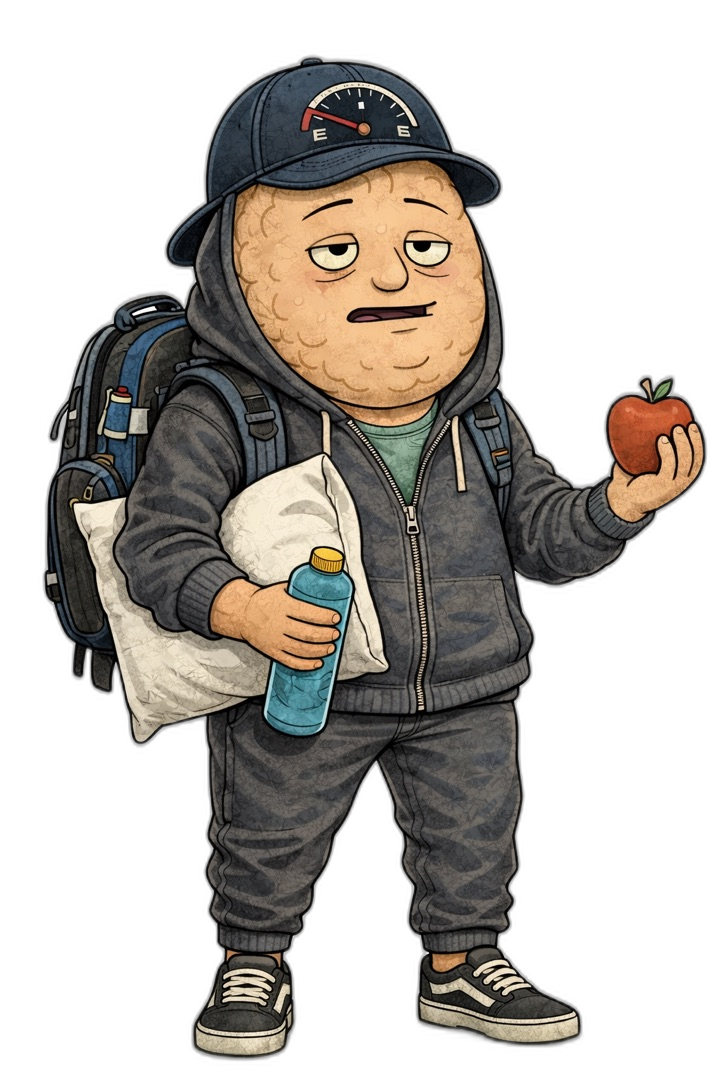
Your brain's energy gauge.
FUEL tracks how much is left in the tank. Sleep, food, stress, connection — FUEL is watching all of it. When FUEL is low, everything is harder. Emotions are bigger. Patience is shorter. It's not attitude. It's an empty tank.
Learning to notice FUEL changes what you ask for—and when you ask for it. Find the Brain Team books and workbooks at anchorpointcalminthestorm.com.
The Landing Zone
Every issue, one tool. Not a program. Not a lecture. One thing you can use this week.
Choose a short, predictable space between arrival and the next demand. It might include a snack, quiet, movement, music, or simply not answering questions for a few minutes.
Try saying:
“You made it home. You do not have to tell me about your day yet. Let’s give your brain a little room to land.”
The Landing Zone is not a promise that there will be no homework, chores, or limits. It is a pause before those things begin. You are helping their system shift from one setting to another instead of demanding an instant change. Making room before asking for more is thoughtful care, and your effort to notice the transition matters.
The Anchor Point App has more tools like this one—built for the real moments, not the ideal ones. anchorpointcalminthestormapp.com.
Composite story based on real experiences. Names changed.
“My student was calm and focused all afternoon, but his grandmother told me evenings were a disaster. I believed her, but I could tell she felt like no one did.
We stopped sending him out the classroom door with three reminders about homework. At home, she stopped asking questions the second he arrived. He got a snack, changed clothes, and had twenty quiet minutes.
The hard evenings did not vanish. But the explosion stopped happening at the front door. His grandmother said, ‘I thought he was saving his worst for me. Now I think he was bringing me what he could not carry anymore.’”
— Anonymous, elementary school counselor
Want to share your story? We’ll never use your name unless you ask us to.
“The Starting Line”
Why “just get started” can feel impossible—and how one smaller question can help a stuck brain find its first step.
“Sometimes the hard behavior at home is not proof that home is the problem. It is proof that home is where they finally stop holding everything in.”
— Kim & Trudy
© Anchor Point · Calm in the Storm · anchorpointcalminthestorm.com
You’re receiving this because you signed up at anchorpointcalminthestorm.com.
To unsubscribe, reply to this email with “unsubscribe” in the subject line.