What to say when a young person is in crisis — because fewer, steadier words can help safety return.
Calm in the Storm
ISSUE #14 | "THE WORDS THAT LAND" FOR THE ADULTS WHO HAVEN'T GIVEN UP
anchorpointcalminthestorm.com
When the Volume Gets Loud.
Hey —
If you've ever tried to talk a young person down from a ledge—literal or metaphorical—you already know how easily words can fail.
They are pacing, crying, or completely enraged. You want to de-escalate the situation, so you start explaining. You tell them why they don't need to be upset. You offer three different solutions. You try to reason with them using logic and calm, rational arguments. And somehow, everything you say seems to make the situation worse.
We understand the impulse. When things feel out of control, you want to use your words to restore order. You want to fix the problem quickly so everyone can feel safe again. That's not a parenting failure—that's instinct. But here's what crisis intervention professionals know: in a high-intensity emotional moment, the brain cannot process paragraphs.
When a young person is in crisis, less is almost always more.
Holding the line with you,
Kim & Trudy Founders, Anchor Point
The Brain in Crisis
Developmentally appropriate support during a frightening or intense emotional moment requires a completely different approach than a normal conversation. When a young person's nervous system is highly activated, their language processing centers slow down. They are not hearing your logic; they are scanning your tone, your posture, and your facial expressions for safety.
If you speak quickly, use complex sentences, or offer multiple choices, their brain perceives it as more overwhelming input. The goal in these moments is not to resolve the underlying issue or teach a lesson. The immediate goal is simply to help their nervous system settle.
This requires the adult to check their own state first. If you are frantic, their alarm may stay high. That does not make you the problem; it means your nervous system is in the room too. Their system is trying to survive the moment. Yours is trying to protect them. Both deserve grace. Go slowly, label the emotion without judging it, and use short, simple, predictable phrases.
(Note: If a young person is in immediate physical danger, experiencing a severe mental health emergency, or unable to stay safe, ordinary de-escalation is not enough. In the United States, dialing or texting 988 connects you directly to the Suicide & Crisis Lifeline for professional, immediate support.)
Meet SCOUT
SCOUT is the fast first responder of the Brain Team. Before the brain processes the actual words someone is saying, SCOUT scans the environment, the tone of voice, and the body language to determine if the situation is safe or threatening. If SCOUT senses a threat, it sounds the alarm, and the rational brain shuts down.
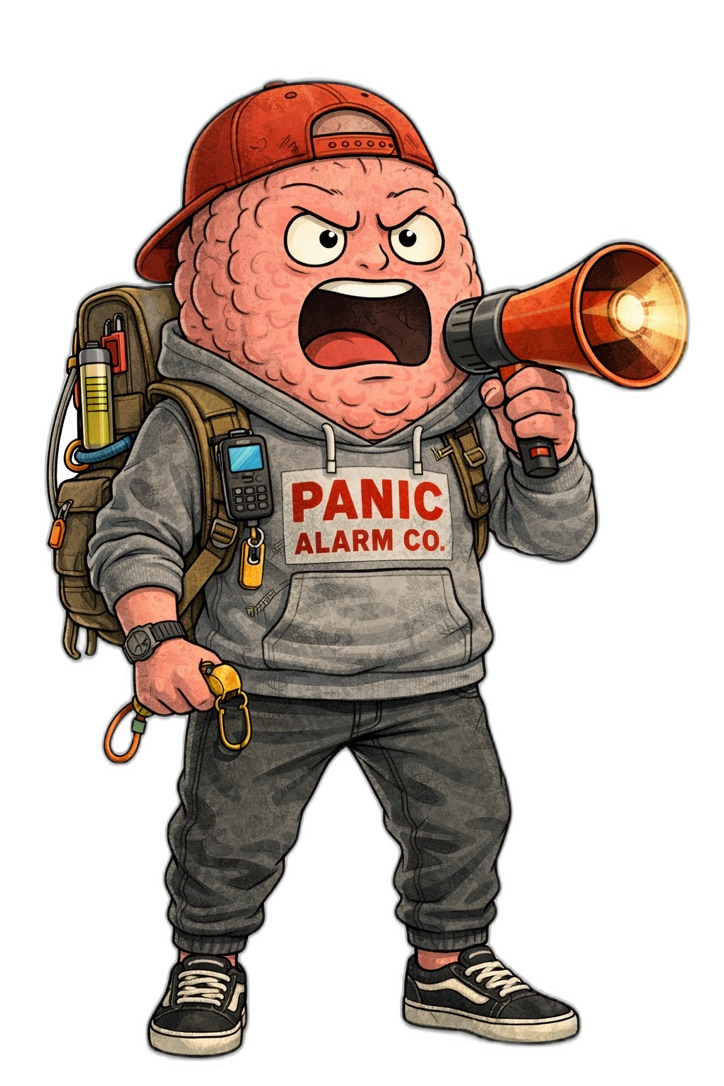
Your brain's alarm system.
SCOUT's job is to keep you safe. When something feels wrong — or even just uncertain — SCOUT fires first and asks questions later. That's not a flaw. That's survival. But sometimes SCOUT goes off when there's no real danger. That's when things get hard.
Understanding how to bypass SCOUT's alarm changes how you communicate in a crisis. Find them at anchorpointcalminthestorm.com.
The Three-Part Anchor
Every issue, one tool. Not a program. Not a lecture. One thing you can use this week.
The next time you are faced with a high-intensity emotional moment, resist the urge to explain, fix, or lecture. Check your own breathing, lower your shoulders, and use this simple, three-part line:
"You're not in trouble. You're not alone. We'll take the next step together."
You are removing the threat of punishment (which calms SCOUT). You are offering connection (which regulates the nervous system). And you are reducing the overwhelming future into one single, manageable step. What they do with that opening is entirely up to them. And sometimes, simple safety is the only thing they can hear. Staying steady enough to offer that safety is real work, and trying counts.
The Anchor Point App has more tools like this one — built for the real moments, not the ideal ones. anchorpointcalminthestormapp.com.
Composite story based on real experiences. Names changed.
"My daughter was having a massive panic attack over a school project. She was hyperventilating, throwing papers, completely inconsolable. My usual move was to grab the rubric and start breaking the project down into steps to show her it wasn't that bad. That usually resulted in her screaming at me.
This time, I just sat on the floor near her desk. I didn't touch the papers. I kept my voice really low and slow, and I just said, 'You're not in trouble. I'm right here.'
She kept crying for another five minutes, but the frantic pacing stopped. She eventually sat on the floor across from me. We didn't talk about the project until the next morning. I realized my 'help' was just adding noise to her storm. She needed quiet safety first."
— Anonymous, mother of a 15-year-old
Want to share your story? We'll never use your name unless you ask us to.
"Still Here"
Why staying connected through the hardest seasons is the single most powerful protective factor you can offer—even when they push you away.
"In a high-intensity emotional moment, the brain cannot process paragraphs. Less is almost always more."
— Kim & Trudy
© Anchor Point · Calm in the Storm · anchorpointcalminthestorm.com You're receiving this because you signed up at anchorpointcalminthestorm.com. To unsubscribe, reply to this email with "unsubscribe" in the subject line.