
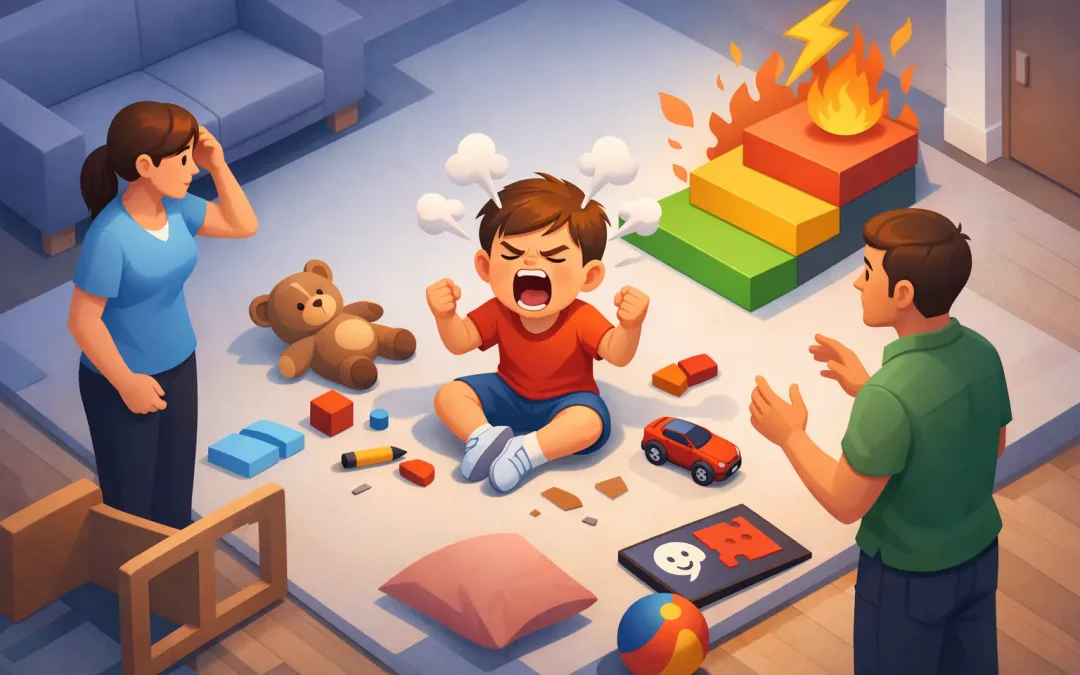
One minute your child is annoyed, and the next they are yelling, sobbing, shutting down, or throwing something across the room. If you have ever thought, why does my child escalate quickly, you are not overreacting, and you are not alone. Fast escalation can feel confusing and personal, but most of the time it is not about disrespect. It is a stress response.
When a child goes from zero to sixty, it usually means their system was already working hard before the obvious behavior showed up. What looks sudden on the outside is often the last visible part of a much longer internal build.
Why does my child escalate quickly in the first place?
Some kids have a very sensitive stress response. Their brains and bodies notice threat fast, even when the situation does not seem like a big deal to the adults around them. A limit, a correction, a change in plans, a sibling comment, a hard transition, or even hunger and noise can land like too much.
This does not mean your child is choosing chaos. It means their ability to stay regulated gets overwhelmed quickly.
Children escalate fast for different reasons. Sometimes they are carrying stress from school, social pressure, poor sleep, sensory overload, or anxiety. Sometimes they have learned that strong behavior is the only way to show that something feels unbearable. Sometimes they are holding it together all day and falling apart in the place that feels safest.
And sometimes the answer is simple but easy to miss. They are tired. Embarrassed. Hungry. Feeling controlled. Running on an already overloaded nervous system.
That is why the same child can handle one disappointment on Tuesday and completely lose it over a smaller problem on Wednesday. Capacity changes.
Fast escalation usually starts before the big behavior
Adults often notice the explosion, but the real shift begins earlier. Your child may get louder, more rigid, more argumentative, more clingy, more restless, or more easily offended before the full meltdown happens. Those are not random attitude problems. They are often early signs of strain.
If we only focus on the moment they cross the line, we miss the pattern. A child who escalates quickly is often a child who has fewer steps between discomfort and distress.
That matters, because it changes the question from, “How do I stop this behavior?” to, “What is happening underneath this behavior?”
What might be underneath the behavior
Behavior is communication, especially when words are no longer working well.
A quick escalation can be driven by anxiety. A child who worries a lot may react strongly to uncertainty, correction, or anything that feels unpredictable. It can also be driven by sensory overload. Noise, texture, touch, crowds, transitions, and too much input can push some kids past their coping point fast.
For other children, the trigger is shame. A simple reminder can feel like exposure. A redirection can feel like failure. If your child has a history of feeling misunderstood, in trouble, or “too much,” they may react hard and fast to protect themselves.
Sometimes the trigger is a need for control. That does not mean your child is manipulative. Control can be a survival strategy when life feels overwhelming. If a child feels powerless inside, they may grip tightly on the outside.
And for some children, especially those with trauma, chronic stress, ADHD, autism, or strong emotional sensitivity, the gap between trigger and reaction is just shorter. They are not taking the long road to upset. Their nervous system takes the shortcut.
What makes escalation worse
When adults are stressed too, we often respond in ways that accidentally add fuel.
Fast talking, repeated questions, lectures, threats, arguing facts, demanding eye contact, or trying to force logic in the heat of the moment usually does not calm a dysregulated child. It often increases pressure. A child in a stress response cannot easily access reasoning, flexibility, or reflection.
This is why punishment in the peak of escalation so often backfires. The child is not in a state to learn from it. They are trying to survive the feeling.
That does not mean there should be no limits. It means timing matters. Safety first, teaching later.
What to do when your child escalates quickly
This is where a simple framework helps. At Anchor Point, we use Notice, Regulate, Respond, Repair because adults need something clear in the moment, not a perfect script.
Notice what is happening
Start by observing without immediately judging. What changed right before the escalation? Was there a demand, transition, disappointment, correction, social stress, or sensory load? What signs show up before the full blowup?
You are looking for patterns, not trying to win an argument.
This step helps you move from “This came out of nowhere” to “I think their system was already overloaded.”
Regulate yourself first
This part is hard and essential. If your child is escalating and your body shifts into anger or panic, your child will feel that pressure too. You do not have to be perfectly calm, but you do need to get steadier.
Slow your voice. Lower your shoulders. Take one breath before you speak. Use fewer words.
A regulated adult gives the child a better chance to borrow some calm. A dysregulated adult often becomes part of the storm.
Respond to the need, not just the noise
Once safety is covered, respond simply. That might sound like, “You are really overwhelmed right now.” Or, “I am here. We are going to get through this.” Or, “I am not going to argue while you are this upset. I will help you get calm first.”
If the child needs space, offer it without sounding rejecting. If they need proximity, stay near without crowding them. If they need a choice, give one small, manageable choice. If they are too flooded to talk, do not force a conversation.
The goal is not to reward explosive behavior. The goal is to reduce distress so the thinking brain can come back online.
Keep limits clear and calm
Support and structure belong together. You can be warm and firm at the same time.
You might say, “I will not let you hit,” while moving back and blocking safely. Or, “You can be upset. You cannot throw things at people.” Or, “We are taking a break, and we will talk when your body is calmer.”
Long explanations are rarely helpful during escalation. Clear, calm, repeated language usually works better.
Why does my child escalate quickly with me, but not at school?
This is one of the most painful questions for caregivers, and it often brings a lot of self-doubt.
Usually, it does not mean your child is manipulating you or that you are the problem. It often means home is where the mask comes off. Many children spend all day using every bit of energy they have to hold it together in structured settings. By the time they get home, their system is spent.
It can also mean your child feels safest with you. Safe does not always look calm. Sometimes safe looks like collapse.
That does not make the behavior okay, and it does not make home life easy. But it does help explain why you may be getting the hardest version of their day.
When to look more closely
If your child escalates quickly often, across settings, or in ways that put them or others at risk, it may be time to get more support. The same is true if the reactions seem extreme for the trigger, recovery takes a very long time, or your child seems constantly on edge.
Support does not mean you have failed. It means the problem deserves more than guesswork.
Sometimes what looks like “bad behavior” is really untreated anxiety, sensory needs, grief, trauma, attention struggles, learning frustration, or a lagging skill in emotional regulation. Naming the right problem changes the response.
What helps over time
Children who escalate quickly usually need more than better consequences. They need more predictable rhythms, more co-regulation, and more practice recovering from stress.
That may mean building in transition warnings, protecting sleep, lowering unnecessary power struggles, noticing early signs sooner, and talking through hard moments after everyone is calm. It may mean teaching your child what their body feels like before they explode, not just talking about behavior after the fact.
It also means remembering that progress is rarely linear. A child can do better for two weeks and still have a huge blowup on a hard day. That does not erase growth. It means they are human, and so are you.
If you are asking why your child escalates so quickly, you are already paying attention to what matters. Under the yelling, the tears, the slammed door, or the total shutdown, there is usually a stressed nervous system asking for help in the least effective way possible. You do not need shame for that. You need a steadier map, a calmer next step, and the reminder that change often starts with feeling safe enough to come back down.

 English (United States)
  English (UK)