
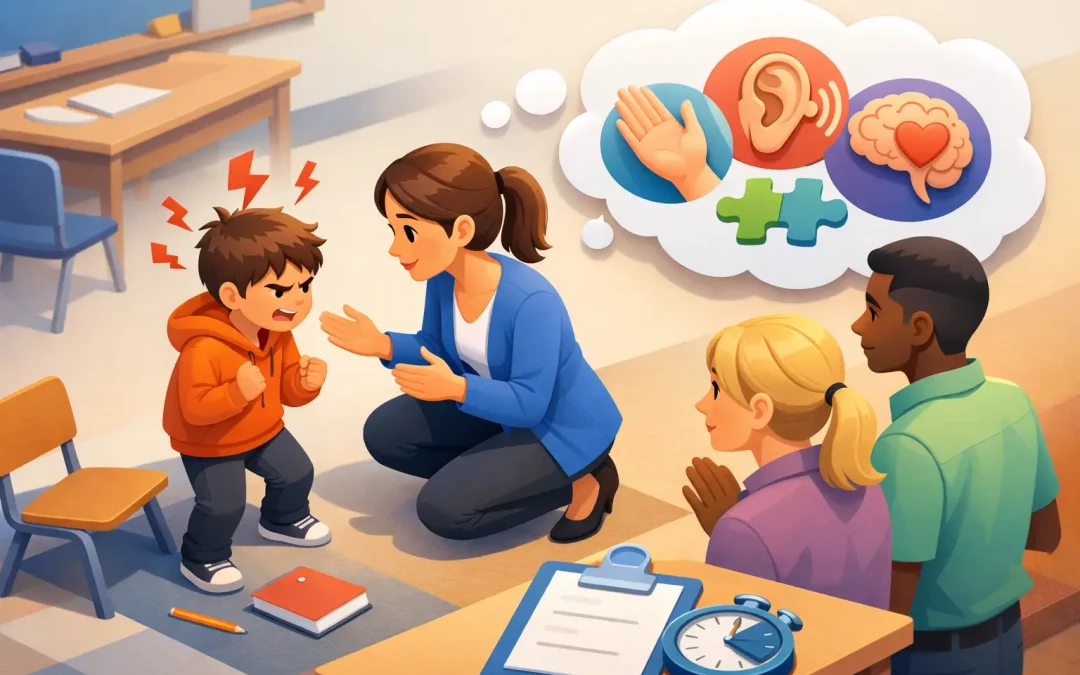
A student knocks over a chair, refuses to move, swears under their breath, or suddenly shuts down with their head on the desk. In that moment, a teacher does not need another reminder to stay calm. They need clear words, a workable next step, and support from the adults around them. This teacher de escalation training review looks at what genuinely useful training should offer school staff when behavior gets hard.
Good de-escalation training does not promise that every student will cooperate or that calm adult behavior will instantly fix a crisis. It gives adults a way to reduce added stress, protect safety, and keep connection possible. That matters because a student who is overwhelmed is rarely able to learn from consequences, lectures, or a power struggle in the moment.
What De-Escalation Training Should Actually Teach
The strongest training starts with a simple truth: behavior communicates something. A student may be communicating fear, shame, confusion, sensory overload, grief, a need for control, or a skill they do not yet have. The behavior may still need a firm limit. Throwing objects, threatening others, or leaving a supervised area cannot simply be ignored. But understanding what may be underneath the behavior helps adults choose a response that lowers risk instead of adding fuel.
Useful training teaches staff to notice the early signs. These can look different from student to student: a clenched jaw, rapid talking, refusal to write, pacing, a blank stare, joking that turns sharp, or a sudden need to leave. By the time a student is yelling, the best window for prevention may have already passed. Teachers need help seeing the smaller signals without treating every difficult moment as a major incident.
It should also teach the difference between a regulated student who is resisting a reasonable expectation and a dysregulated student whose nervous system is in alarm. Sometimes students do test limits. Sometimes they avoid work. Often, though, stress and skill gaps are mixed into the picture. Starting with curiosity does not mean removing expectations. It means choosing regulation before correction when a child cannot access their better thinking.
A Teacher De Escalation Training Review: What to Look For
When reviewing a program, look beyond polished slides, certificates, and broad phrases such as “trauma-informed.” Ask whether teachers leave with language they can use during third-period math, in a crowded hallway, or while twenty-five other students are watching.
A practical program should cover four connected skills: noticing stress, regulating the adult response, responding in a way that reduces pressure, and repairing after the incident. Anchor Point calls this Notice, Regulate, Respond, Repair. It is simple enough to remember when the room feels anything but simple.
Notice without rushing to judgment
Training should help staff separate observation from interpretation. “Jordan pushed his book away, put his head down, and said, ‘Leave me alone’” is an observation. “Jordan is being disrespectful because he does not care” is an interpretation.
This shift is not about excusing harm or pretending classroom expectations do not matter. It gives the teacher more choices. If Jordan is overwhelmed by the task, public attention, or a conflict from lunch, a correction delivered with force may make the situation bigger. If he is trying to avoid work, a calm and consistent boundary may still work better than a public confrontation.
Regulate the adult first
A training program should be honest about this: adults get activated too. A student’s yelling can bring up embarrassment, fear, anger, or the feeling of losing control in front of the class. None of that makes a teacher bad at their job. It makes them human.
But students often borrow the emotional temperature of the adults nearby. Training should offer small, realistic reset tools: lower your voice, relax your shoulders, take one slower breath, create a few feet of space, and ask for backup early. These are not magic tricks. They are ways to keep an adult’s nervous system from joining the escalation.
Be cautious of programs that place the entire burden on one teacher to stay perfectly composed. Schools need team plans, administrative follow-through, and clear procedures for getting help. Calm is easier when staff are not left alone.
Respond with fewer words and more options
During a high-stress moment, long explanations usually do not land. Effective training gives adults brief phrases that preserve dignity while holding boundaries. For example:
“Something feels too big right now. We can talk when your body is quieter.”
“I am not going to argue with you. You can take two minutes at the calm table or get a drink of water with me.”
“You do not have to like this limit. You do need to keep your hands and feet safe.”
“I can see you are done talking. I will check back in five minutes.”
These responses work because they are clear, not because they are clever. They reduce public pressure, avoid a debate, and give the student a small sense of choice. Training should explain when to offer choices and when safety requires a more direct response. If there is an immediate risk of harm, staff must follow school safety procedures and call for the appropriate support. De-escalation is not a substitute for emergency planning.
Repair instead of pretending it never happened
Many programs teach the crisis response but skip what comes next. That is a missed opportunity. Repair helps students return to learning and helps teachers avoid carrying resentment from one incident into the next.
A repair conversation can be short. “Yesterday was rough. I am glad you are here today. We still need to figure out how to handle anger without throwing things. What would help next time?” The adult can acknowledge their own part when needed: “I raised my voice. I am working on handling that differently.”
Repair is not a free pass. It is where accountability can become teachable. The student may need to clean up, apologize, make a plan, or practice a different skill. The difference is that these steps happen after enough calm has returned for learning to be possible.
Signs a Training Program May Fall Short
Some de-escalation training is more about compliance than support. It may focus heavily on getting students to obey quickly, use scripts that sound unnatural, or frame every challenging behavior as manipulation. Those approaches can increase shame and push adults toward control battles.
Be wary if a program offers little guidance for neurodivergent students, students with trauma histories, or young people who communicate distress differently. A one-size-fits-all approach can miss the child standing right in front of you. Training should help staff adapt without assuming they can diagnose the reason for every behavior.
It may also fall short if it treats restraint, removal, or exclusion as the main answer. There are times when safety action is necessary, and schools must follow their policies and legal requirements. Still, the best training puts prevention, early support, and relationship repair at the center. Crisis intervention skills matter, but they should not be the only skills staff receive.
Questions to Ask Before Choosing Training
Before a school invests time and money, leaders can ask whether the training gives staff practice, not just information. Do participants role-play realistic situations? Do they learn how to support the rest of the class while one student is struggling? Is there guidance for communicating with families without blame? Does the program account for different ages, settings, and levels of risk?
Also ask what happens after the workshop. One afternoon of training can create shared language, but it rarely changes school culture by itself. Staff benefit from refreshers, coaching, simple visual reminders, and leadership that responds consistently. A teacher cannot use a calm plan if the response changes depending on who is called to the room.
The most helpful training leaves people feeling more prepared, not more judged. It should not ask educators to become therapists or to absorb unsafe behavior without support. It should help them recognize that a hard moment is not a personal failure and that a steady response can make the next moment safer.
Students do not need perfect adults. They need adults who can slow down, set a clear limit, and return after the storm with respect intact. That kind of skill builds safer classrooms one difficult moment at a time.

 English (United States)
  English (UK)