
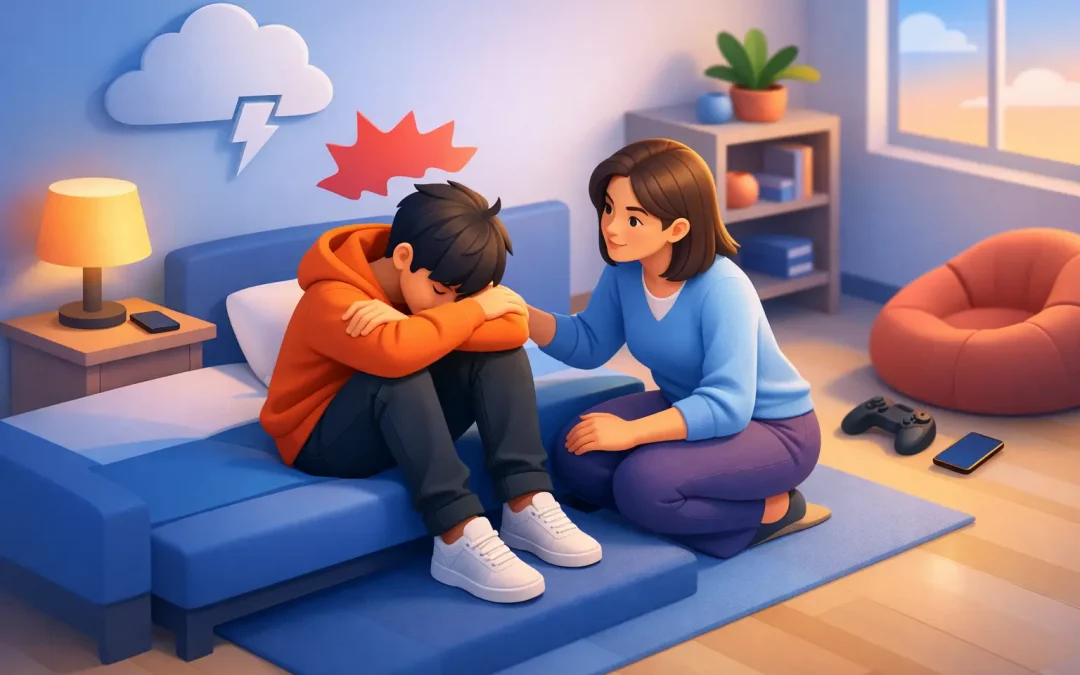
The hardest part often comes after the yelling stops.
A teen slams a door, says something cutting, throws a backpack, or explodes over what looked like a small limit. The room goes quiet, but everyone still feels charged. If you are supporting teens after angry outbursts, that quiet can feel confusing. Do you bring it up right away? Do you let it go? Do you give a consequence, ask for an apology, or just try to survive the rest of the day?
This is the moment many adults get stuck. Not because they do not care, but because they care a lot and are running on stress too. What helps most here is not a perfect script. It is a steady process: Notice, Regulate, Respond, Repair.
What an angry outburst is really telling you
An angry outburst is not always about disrespect, manipulation, or refusal. Sometimes it is, in part, about poor choices. Teens are still responsible for behavior. But responsibility makes more sense when we also understand what is happening underneath.
Most angry explosions happen when a teen is overloaded. That overload may come from embarrassment, fear, hunger, school stress, social pressure, sensory overload, grief, shame, or feeling cornered. Some teens go loud when their nervous system is overwhelmed. Others shut down, leave, or become sarcastic and sharp.
That does not make hurtful behavior okay. It does help explain why lecturing in the heat of the moment usually goes nowhere. A dysregulated teen cannot make good use of a long conversation about choices, respect, or consequences while their system is still in alarm.
When adults treat every outburst like a character issue, things often get worse. When adults see behavior as communication, they can respond with more clarity and less power struggle.
Supporting teens after angry outbursts starts with regulation
The first job is not teaching. The first job is settling the storm enough for thinking to come back.
That starts with you. If your own heart is racing, if you are replaying what they said, if part of you wants to win the argument, pause before you move in. Take one breath. Unclench your jaw. Lower your voice. Slow your body down on purpose.
Teens notice our nervous systems before they absorb our words. A calm adult does not guarantee a calm teen, but it does reduce the chances of a second explosion.
Then look at immediate safety. Is anyone at risk? Is property being damaged? Does your teen need space, water, quiet, or distance from siblings? Safety comes before conversation every time.
Sometimes the most helpful response sounds like, “I am not going to argue with you right now. We can talk when things are calmer.” Or, “You are really flooded. Go take space. I will check on you in ten minutes.” That is not giving in. It is choosing regulation over escalation.
What to do in the first 10 to 30 minutes
After an outburst, many adults feel pressure to address it immediately. Sometimes that works. Often, it backfires.
The better question is not, “Do we talk now?” It is, “Is my teen able to think, listen, and stay with me without blowing up again or shutting down completely?” If the answer is no, wait.
In that first stretch of time, keep your communication short and clear. Avoid stacked questions, sarcasm, and emotional cross-examination. A teen who is coming down from anger usually does better with simple statements than with a demand to explain themselves.
You might say, “We are taking a pause.” Or, “I am here when you are ready.” Or, “We will deal with what happened, but not while we are both upset.”
If your teen is receptive, offer regulation without making it feel childish. A drink of water, a shower, headphones, a walk, sitting in the car, throwing a basketball, or just being left alone for a bit can all help. What works depends on the teen. Some need connection first. Some need space first. It depends on whether closeness feels soothing or overwhelming to them in that moment.
When your teen is calm enough, move into repair
Repair is not the same as pretending nothing happened. It also is not a courtroom.
A repair conversation works best when it is brief, grounded, and focused on understanding plus accountability. Start with what you noticed rather than an accusation. “You got really angry when I said no to going out.” “It seemed like things built up fast after school.” “I could tell that hit a nerve.”
This lowers defensiveness because you are naming the moment, not attacking the teen’s character.
Then get curious. Not interrogating, just curious. Try, “What was going on for you right before that?” “What did you need in that moment?” or “What made that feel so big?” A teen may not know right away. That is okay. Sometimes the first answer is, “I don’t know.” Stay calm and keep the door open.
If they are ready, bring in accountability without shame. “It makes sense that you were overwhelmed. It is not okay to scream at me and throw things.” Both parts matter. The first builds safety. The second builds responsibility.
That balance is where real learning happens.
Supporting teens after angry outbursts without making things worse
There are a few common responses that feel natural to adults but tend to increase shame, defensiveness, or shutdown.
One is insisting on a full apology before the teen is regulated enough to mean it. Another is delivering a long lecture because the adult has been holding in fear, frustration, or hurt. A third is acting like the event never happened because everyone wants relief.
None of these are unusual. They are stress responses too.
But if you want change, aim for steadiness over intensity. A shorter conversation is often more effective than a big emotional processing session. Clear consequences work better than reactive punishment. And a real repair matters more than a forced apology.
A consequence may still be needed, especially if someone was hurt, property was damaged, or a clear boundary was crossed. The key is to connect the consequence to the behavior and deliver it calmly. Not as payback, and not as proof of who is in charge.
For example, if a phone was used to escalate conflict, a break from the phone may make sense. If a wall was damaged, helping repair or pay for it may make sense. Consequences should help rebuild responsibility, not deepen humiliation.
What repair can sound like in real life
Many adults need language more than theory. Here are the kinds of phrases that support repair:
“I know you were overwhelmed. I also need our home to feel safe.”
“You are not in trouble for having big feelings. We do need to work on what you do with them.”
“Let’s figure out what your warning signs were before things blew up.”
“Next time, what can you do earlier? What can I do earlier?”
“We can reset from this.”
That last one matters. Teens need to know that hard moments do not erase the relationship.
Look for patterns, not just incidents
If angry outbursts are happening often, focus less on each explosion by itself and more on the pattern around it.
When do the outbursts happen most? After school? Around limits? During transitions? After social conflict? When sleep is off? When a teen feels embarrassed or controlled? The pattern gives you better information than the outburst alone.
This is where a simple framework like Notice, Regulate, Respond, Repair can be so helpful. Notice the cues and context. Regulate yourself first. Respond in a way that lowers heat. Repair after the storm. Over time, this creates more predictability for both you and the teen.
It will not make conflict disappear. It can make conflict less damaging and more workable.
If nothing seems to help
Sometimes outbursts are getting more intense, lasting longer, or involving threats, self-harm, aggression, or major destruction. Sometimes a teen seems constantly on edge, and the whole family is walking on eggshells.
That is a sign to widen support. You do not have to carry this alone. Extra support can help you understand what is driving the behavior and build a more consistent plan around safety, regulation, and communication.
Needing more help does not mean you failed. It means the situation needs more support than one stressed adult can provide in the middle of daily life.
If you are the adult in the room trying to hold steady after another hard moment, take heart. Teens can learn new ways to move through anger, and relationships can recover from ugly, painful incidents. Change rarely comes from one perfect conversation. More often, it grows from many ordinary moments where an adult stays grounded, sets a clear boundary, and comes back to repair.
That is not small work. It is the work that helps a teen feel safe enough to do better next time.

 English (United States)
  English (UK)