
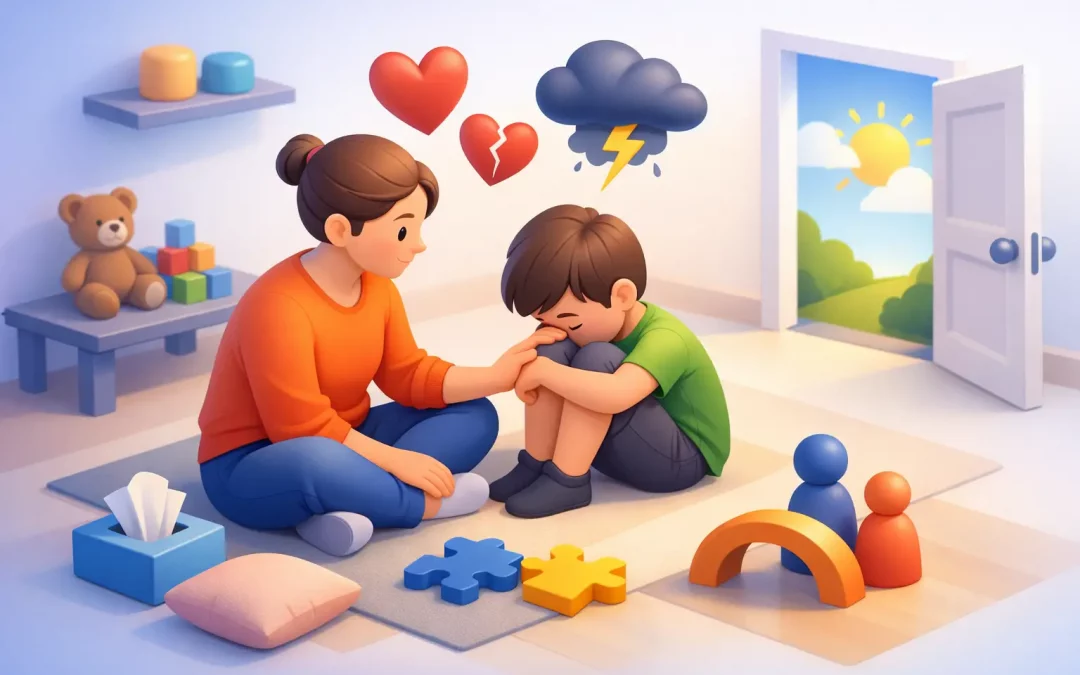
A child slams a door, refuses to move, swears at you, or melts down over something that seemed small. In that moment, most adults are not looking for a perfect parenting philosophy. They need to know what to do next. This relational discipline guide offers a steadier path: address the behavior, protect safety, and keep the relationship intact.
Relational discipline is not permissive. It does not mean ignoring harmful behavior, giving in to every demand, or letting a young person run the room. It means remembering that a dysregulated child or teen cannot learn well from fear, shame, or a power struggle. They need an adult who can hold a boundary without adding more heat.
That can be difficult when you are tired, embarrassed, worried, or being yelled at. You do not need to be perfectly calm. You need a simple way to return to steadiness.
What relational discipline means in real life
Discipline means teaching. Relational discipline teaches children and teens what to do with big feelings, what limits exist, and how to repair harm after a hard moment. The relationship is not a reward for good behavior. It is the safe base that makes learning possible.
A consequence may still be needed. A child who throws a tablet may lose access to the tablet for the evening. A teen who damages property may need to help repair or replace it. But the purpose is not to make them suffer enough to remember. The purpose is to connect the action to a clear responsibility and help them practice a better next step.
This approach also asks a different question. Instead of only asking, “How do I stop this behavior?” ask, “What is this behavior telling me, and what needs to happen now?” Sometimes the answer is a firm limit. Sometimes it is food, space, sleep, less talking, or help getting through a transition. Often, it is both a limit and support.
The relational discipline guide: Notice, Regulate, Respond, Repair
When behavior gets intense, it helps to use the same sequence every time. At Anchor Point, that sequence is Notice, Regulate, Respond, Repair. It gives adults something to hold onto when their own nervous system wants to react.
Notice what is happening underneath
Start with the facts. What do you see and hear? What changed just before this moment? Is the young person hungry, overwhelmed, embarrassed, disappointed, rushed, corrected in front of others, or struggling with a task that feels impossible?
Behavior is communication, even when the message comes out sideways. A child screaming “I hate you” may be saying, “I cannot handle this feeling.” A student putting their head down and refusing work may be saying, “I am lost, ashamed, or already overloaded.” A teen who seems disrespectful may be trying to regain control when they feel powerless.
Understanding the reason does not excuse hurtful behavior. It simply helps you respond to the real problem rather than getting pulled into the surface argument.
Try naming what you notice with few words: “This feels like too much right now.” “You are really upset about stopping.” “I can see you are not ready to talk.” Avoid interrogating, lecturing, or demanding an explanation in the peak of the storm. A flooded brain usually cannot provide one.
Regulate yourself before you lead
A child borrows the nervous system of the adult nearby. If your voice gets louder, your body moves closer, or your words become sharp, their alarm may rise further. This is not a character flaw. It is how stress works.
Before you speak, take one slower breath. Drop your shoulders. Unclench your jaw. Lower your voice rather than raising it. If it is safe to do so, give yourself a few seconds before responding.
You might say, “I am going to take a breath so I can help.” Or, “I am here. We are going to get through this.” These phrases are not magic. They are cues of safety, for both of you.
Regulation does not mean becoming passive. You can be calm and clear at the same time: “I will not let you hit.” “You can be mad, but you cannot throw things at people.” “I am stepping back. We can talk when voices are lower.”
If you are too activated to respond well, it is okay to pause when safety allows. Ask another adult to step in, get a drink of water, or stand quietly nearby instead of continuing an argument. Taking a reset is responsible, not abandoning.
Respond with a limit and a next step
During dysregulation, use fewer words than you think you need. Long explanations often sound like pressure to a stressed brain. A simple response usually works better: name the limit, offer a manageable choice, and stay nearby if the young person can tolerate it.
For example: “I will not let you kick the door. You can sit on the porch or in your room. I will check on you in five minutes.” For a student: “You do not have to do the whole page right now. Start with number one, or take a two-minute break and come back.”
Choices should be real, limited, and acceptable to you. “Do you want to clean this up now or after you have had ten minutes to settle?” is useful. “What do you want to do?” may be too broad in a heated moment.
There are times when a stronger response is needed. If someone is at risk of being hurt, prioritize safety. Move people apart, remove dangerous objects, call for support, and use the procedures available in your home, school, or setting. Relational discipline is not a reason to leave others unsafe. Safety is part of care.
Repair after the storm
The most meaningful teaching often happens after everyone has settled. Repair is where a young person learns that mistakes matter and relationships can recover.
Begin without a lecture. “That was a hard moment. Are you ready to talk about what happened?” If they are not ready, try later. Timing matters. Some children can process quickly; others need much more space.
When they can talk, stay curious. Ask what was happening before things escalated, what their body felt like, and what could help next time. Then address the impact plainly: “Your sister was scared when the chair was thrown.” “The words you used hurt me.” “The classroom could not continue while people were yelling.”
A repair should fit the harm. It may include an apology, helping clean up, checking on someone who was hurt, replacing something damaged, or practicing a different response. It can also include making a plan: “Next time you feel that trapped, show me the break signal instead of leaving the room.”
Adults repair, too. If you yelled, used shaming words, or handled the moment in a way you regret, own it. “I was frustrated and I raised my voice. That was not how I want to speak to you. I am sorry.” This does not weaken your authority. It teaches accountability better than a perfect speech ever could.
Common worries about a relational approach
Some adults worry that calm support will teach children to manipulate them. But supporting a dysregulated nervous system is not the same as giving a child whatever they demand. You can validate the feeling and keep the limit: “You really want more game time. The answer is still no.”
Others worry that there are no consequences. There can be consequences, but they work best when they are connected, proportionate, and delivered without humiliation. A consequence given in anger may stop behavior briefly. It may also teach a child to hide, lie, or fight harder. A consequence delivered with calm helps the child connect action, impact, and responsibility.
It also depends on the child, the setting, and the pattern. A one-time outburst after a difficult day needs a different response than repeated aggression, ongoing school refusal, or a young person who is regularly unsafe. When the behavior is frequent, severe, or getting worse, bring in additional support. Needing help is not evidence that you have failed.
Start smaller than you think
You do not have to change every hard moment at once. Pick one sentence to practice this week: “You are having a hard time. I am going to help you keep everyone safe.” Or: “We can talk when we are both calmer.”
Then notice what happens inside you. The goal is not never feeling frustrated. The goal is having a path back when frustration shows up. Each time you pause, set a clear limit, and return for repair, you show a young person something powerful: hard feelings can be held, harm can be addressed, and connection does not disappear when life gets messy.

 English (United States)
  English (UK)