
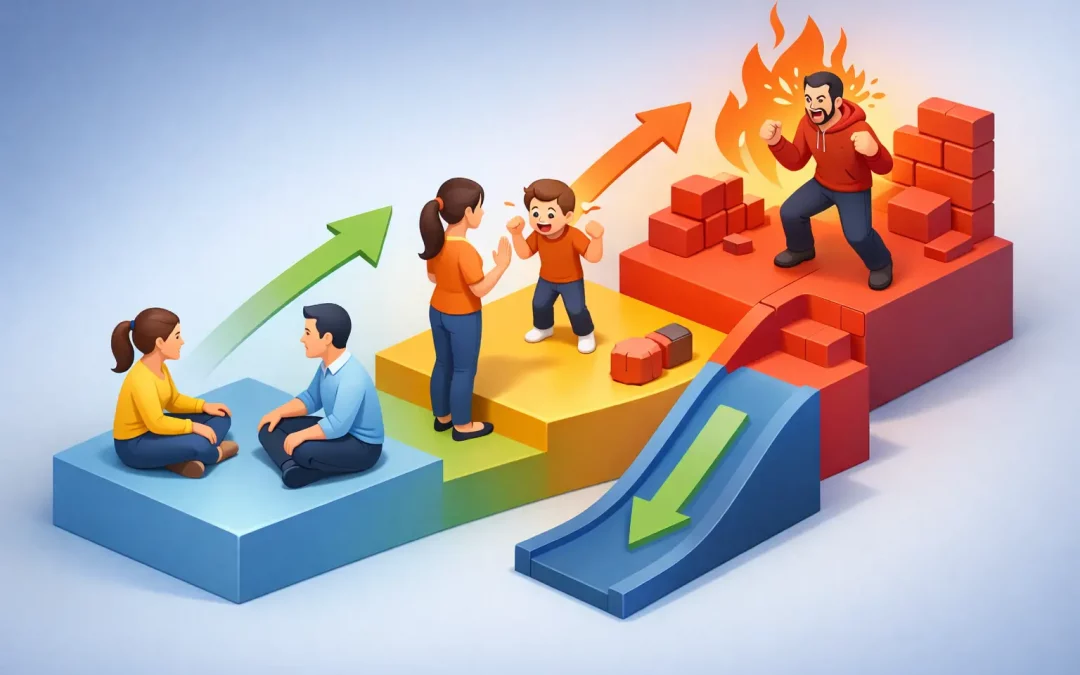
The moment right before a blowup is easy to miss. A child gets louder. A teen goes quiet. A student starts pacing, arguing, refusing, or shutting down. Adults often feel pressure to stop the behavior fast, but that is usually the point where things get bigger, not better. If you are trying to figure out how to prevent behavior escalation, the most helpful shift is this: stop treating the behavior as the whole problem and start looking at the stress underneath it.
Behavior escalation usually does not come out of nowhere. It builds. There are signals, patterns, and pressure points. When adults learn to notice those early and respond with steadiness, many hard moments can soften before they turn into a full power struggle, shutdown, or crisis.
What behavior escalation really is
Escalation is what happens when stress keeps rising and neither the young person nor the adult is able to bring things back down. Sometimes it looks loud – yelling, throwing, arguing, threatening, running. Sometimes it looks quiet – refusal, silence, hiding, freezing, or walking away. Both matter.
At the center of escalation is a nervous system under strain. A child or teen may feel overwhelmed, cornered, embarrassed, powerless, confused, or unsafe. That does not mean every behavior is okay. It means the behavior is carrying information. When adults respond only to the surface behavior, they often miss the reason it is happening.
This is why punishment, lectures, and repeated demands can backfire in heated moments. They may increase pressure on a system that is already overloaded. The result is often more intensity, not more cooperation.
How to prevent behavior escalation by catching it early
Prevention starts long before the peak moment. Most youth show early signs that stress is climbing. The challenge is that these signs can look like attitude, avoidance, or defiance if you are already tired and stretched thin.
Early signs might include talking faster, getting stuck on fairness, asking the same question over and over, whining, restless movement, sarcasm, withdrawing, clinging, or a sudden change in tone. In school it may look like putting a head down, refusing work, bothering peers, or asking to leave the room repeatedly.
When you notice these shifts, think: this is the beginning, not the end. That mindset alone changes your response. Instead of moving in harder, you can move in earlier and calmer.
A simple way to do that is to use Anchor Point Calm in the Storm’s steady framework: Notice, Regulate, Respond, Repair. It helps adults stay organized when emotions are high.
Notice what is changing
Start by observing without judgment. What is different right now? Is the child getting louder, more rigid, more avoidant, more sensitive to correction? Did something happen just before the shift – hunger, noise, transition, disappointment, social conflict, a demand that felt too hard?
Noticing is not the same as excusing. It is gathering the right information so your next step actually helps.
Regulate yourself first
Adults often skip this part because it feels urgent to act. But your nervous system sets the tone. If your face tightens, your voice sharpens, or your body moves in with intensity, a stressed child usually reads that as danger or control.
Regulating yourself does not mean becoming perfectly calm. It means lowering your own heat enough to respond on purpose. Slow your breathing. Unclench your jaw. Drop your voice. Pause before repeating a demand. If possible, plant both feet on the ground and remind yourself, This child is having a hard time, not giving me a hard time.
That pause can change the entire direction of the moment.
What to do instead of getting pulled into the escalation
Once stress is rising, your goal is not to win. Your goal is to reduce threat, increase safety, and create enough space for regulation to come back online.
Often that means using fewer words. Long explanations and rapid-fire questions can feel like more pressure. A child in distress usually needs simple language, clear limits, and a calm presence.
Try short, steady responses like, “I can see this is getting hard.” “You’re safe. I’m here.” “Let’s slow this down.” “You don’t have to talk right now.” “We can figure this out when things are calmer.” These phrases work because they reduce demand while still offering structure.
If a limit needs to be set, keep it brief and grounded. “I won’t let you hit.” “I won’t argue with yelling.” “We can take space and talk after.” The tone matters as much as the words. Calm limits help. Tight, reactive limits often intensify the struggle.
Reduce pressure where you can
Many escalations grow because the young person feels trapped. They may believe they have no way to succeed, no way to save face, or no way to regain control. Giving appropriate choices can lower that pressure.
That might sound like, “Do you want to sit here or in the hall?” “Do you want help getting started or a two-minute break first?” “You can tell me now or after dinner.” Small choices can restore a sense of control without giving up the adult role.
This is also the time to adjust expectations if needed. Not every moment is the right time for a lesson, a consequence talk, or a full conversation about respect. Sometimes the most effective response is to deal with safety first and teaching later.
How to prevent behavior escalation in common trigger moments
Certain situations predictably increase stress. Transitions, correction, sibling conflict, homework, bedtime, public settings, and unexpected changes are common flashpoints. Prevention works best when you plan for the moments that usually go sideways.
For a child who struggles with transitions, extra warnings and visual cues may matter more than another reminder to “listen.” For a teen who escalates when corrected in front of others, private feedback may work far better. For a student who unravels during hard tasks, reducing the workload or offering a first step can prevent shutdown or refusal.
This is the trade-off adults often face: what feels firm in the moment is not always what is effective. Preventing escalation sometimes looks less like pushing through and more like adjusting the setup. That is not being permissive. It is being strategic.
Watch for shame
Shame is a major accelerator. When a child feels exposed, embarrassed, or like they are the problem, behavior often gets bigger fast. Public correction, sarcastic comments, comparisons, and “you always” statements can pour fuel on the fire.
Protecting dignity matters. Correct privately when possible. Stay away from labels. Focus on what needs to happen next, not on character judgments. A child who feels safe enough to recover is much more likely to regain control.
After the moment, repair matters
If you want fewer escalations over time, do not stop at surviving the incident. Go back and repair. That does not mean there are no consequences. It means the relationship gets attention too.
Later, when everyone is calmer, get curious. What was hard about that moment? What did the child notice in their body? What made it worse? What helped even a little? What can be different next time?
Keep the conversation simple and respectful. This is not a cross-examination. It is a chance to build insight and a plan. Many kids and teens do better when they can help create the next-step strategy. They may know, for example, that being rushed, corrected publicly, or pushed to talk immediately makes things worse.
Repair also includes the adult side. If you yelled, threatened, or handled it in a way you regret, own that clearly. “I was too sharp. I want to handle that better next time.” That does not weaken your authority. It builds trust and shows what accountability looks like.
When prevention does not work perfectly
Even with good tools, some moments will still escalate. That does not mean you failed. It means the stress load was bigger than the supports available in that moment.
Some youth carry trauma, anxiety, neurodivergence, grief, sensory stress, or chronic overwhelm that makes escalation more likely. Some adults are supporting kids while running on empty themselves. Real life is messy. Progress is not measured by never having a hard moment. It is measured by noticing earlier, recovering faster, and causing less harm along the way.
If you remember nothing else, remember this: behavior usually gets bigger when people feel less safe, less understood, and less in control. It softens when adults bring steadiness, clarity, and connection.
You do not need perfect words. You do not need to control every outcome. You need a way to notice what is happening, regulate your own response, and offer calm structure in the middle of stress. That is how trust grows. That is how hard moments change over time. And that is how children and teens learn that even in their worst moments, they are not alone.

 English (United States)
  English (UK)