
A 6-year-old can go from laughing at breakfast to sobbing over the wrong color cup in less than a minute. If you are looking for emotional regulation activities for 6 year olds, you probably do not need more theory. You need simple things that help in real moments, when a child is overwhelmed, stuck, frustrated, or falling apart.
At this age, big feelings are not a sign that something is wrong. They are often a sign that a child’s nervous system is overloaded. Six-year-olds are still learning how to notice what they feel, name it, and do something with it. That means regulation usually starts with the adult. Your calm matters. Your pace matters. And the goal is not to stop feelings. The goal is to help the child move through them safely.
What emotional regulation looks like at age 6
A 6-year-old may know words like mad, sad, or scared, but that does not mean they can use those words when upset. In a hard moment, many children this age lose access to language, problem-solving, and flexibility. What looks like backtalk, silliness, refusal, or a meltdown is often stress showing up through behavior.
That is why emotional regulation activities work best when they are concrete and sensory, not lecture-based. A dysregulated child usually cannot talk their way back to calm. They need rhythm, movement, breath, connection, and repetition.
It also helps to remember that not every strategy works for every child. Some kids calm with stillness. Others need movement first. Some want closeness. Others need space with gentle supervision. It depends on the child, the setting, and how activated they are.
Emotional regulation activities for 6 year olds that help in real life
The most effective activities are the ones you can return to again and again. They should feel doable, not perfect.
Balloon breathing with something to watch
Telling a 6-year-old to take a deep breath often falls flat. Giving them an image helps. Have them put both hands on their belly and pretend they are slowly inflating a balloon, then letting the air out. You can say, “Smell the soup, cool the soup,” or “Fill the balloon, slowly let it go.”
This works best when the child is mildly to moderately upset, not in the peak of a meltdown. If they are too activated, start with movement first and come back to breathing later.
Wall pushes for big energy
Some children need to push against something solid when their body feels too full. Invite them to put both hands on the wall and push hard for a count of ten. Then rest. Then do it again.
This gives their body heavy work, which can be grounding and organizing. It is especially helpful for frustration, anger, or restless energy. In a classroom, desk pushes or chair pushes can do the same job more quietly.
Animal walks across the room
Bear walks, crab walks, frog jumps, and slow turtle crawls can shift a child out of overwhelm and back into their body. These are not just cute games. They give rhythm, pressure, and movement, which can help settle the nervous system.
If a child is spiraling, try saying, “Your body looks really busy. Let’s do two bear walks to the door and back.” Keeping it short matters. Too many directions can make a stressed child feel even more overloaded.
Feelings check-ins with simple visuals
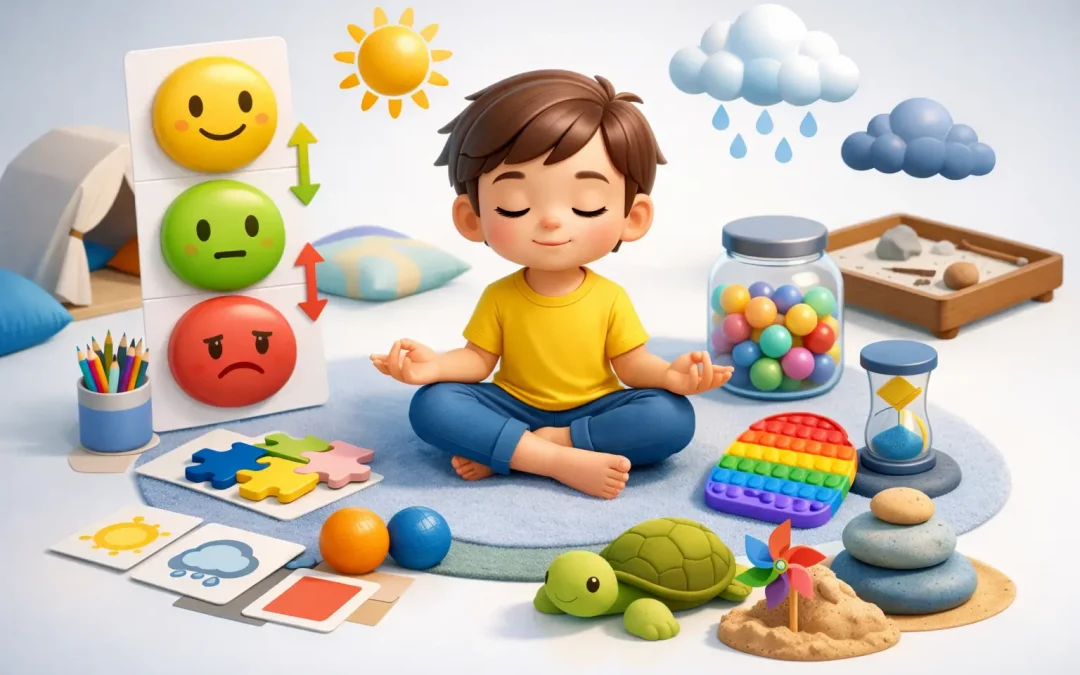
Many 6-year-olds do better with pictures than questions. A feelings chart with faces, colors, or zones can help them identify what is happening before it spills over. You might ask, “Do you feel red, yellow, blue, or green?” or “Which face looks like your body right now?”
This is most useful when practiced during calm times. In the middle of distress, a child may not be able to answer. That is okay. You are building the skill over time, not demanding insight on command.
A calm corner that is not a punishment
A calm space can help if it feels safe and supportive, not like exile. This might be a beanbag, a soft rug, a basket of sensory tools, paper for drawing, headphones, or a stuffed animal. The message is, “This is a place to help your body feel better,” not, “Go away until you act right.”
Some children use a calm corner independently. Others need you nearby. Co-regulation often comes before independence. Sitting close and saying very little can be more effective than trying to fix the feeling.
Scribble, rip, squeeze
When feelings are intense, hands often need something to do. Let the child scribble hard on paper, tear scrap paper, squeeze play dough, or crush a pillow. These activities create release without causing harm.
This can be especially useful for children who get stuck in anger or shame after a mistake. The body needs somewhere for that energy to go.
Rhythm games and counting patterns
Clapping patterns, tapping knees, marching to a count of eight, or tossing a soft ball back and forth can help organize a child who feels scattered. Rhythm is regulating because it gives the brain something predictable to follow.
If you work with a child who gets silly, impulsive, or emotionally wobbly during transitions, rhythm can help bridge the gap. A simple “clap-clap-pat” game on the way to dinner or cleanup can make a bigger difference than another reminder.
Name it with very few words
This is not a craft or a game, but it is one of the strongest tools. When a child is upset, use short language that helps them feel understood. “You wanted it to go differently.” “That felt unfair.” “Your body is having a hard time.”
Feeling seen can reduce the need to escalate. Long explanations usually do not help in the moment. Short, grounded words do.
How to choose the right activity in the moment
A good question is not, “What should this child do right now?” It is, “What is their nervous system asking for?”
If the child is fiery, loud, kicking, or bursting with energy, start with movement or heavy work. Wall pushes, animal walks, carrying a stack of books, or stomping to a rhythm may help.
If the child is tearful, frozen, clingy, or shut down, start with connection and comfort. Sit nearby. Offer a drink of water. Lower your voice. Try a visual check-in or a soft squeeze object.
If the child is mildly dysregulated and still reachable, breathing, drawing, or simple problem-solving may work. But if they are already far gone, skip the lesson. Regulate first. Respond later. That is where the Notice, Regulate, Respond, Repair approach helps. You notice what is underneath the behavior, regulate the nervous system, respond with clarity, and come back to repair if the moment went sideways.
What gets in the way
Sometimes adults try a regulation activity and it seems to fail. Usually that does not mean the activity is bad. It means the timing, delivery, or match was off.
A child who feels controlled may reject even a good strategy. Invitation works better than force. “Want to try wall pushes or frog jumps?” lands differently than “Go calm down.”
It also helps to practice these tools when the child is already calm. If every strategy only appears during conflict, it can start to feel like correction. Build them into ordinary parts of the day. Do balloon breathing before bed. Use animal walks on the way to the bathroom. Try a feelings chart at breakfast.
And keep your expectations gentle. Regulation is not a straight line. A child may use a tool beautifully one day and refuse it the next. That is normal.
Helping 6-year-olds build regulation over time
The long game is not getting a child to stop crying faster. The long game is helping them recognize what is happening in their body and trust that they can get through it.
That grows through repetition and relationship. It grows when adults stay steady enough to borrow calm to the child. It grows when we stop treating distress like misbehavior first and start seeing it as communication.
You do not need a perfect script. You do not need a color-coded behavior plan for every hard moment. You need a few reliable tools, a calm pace, and the reminder that skills take practice.
For many families, the most powerful emotional regulation activities for 6 year olds are surprisingly simple. Push the wall. Breathe like a balloon. Crawl like a bear. Tear paper. Sit close. Name the feeling with a few steady words. Small things, repeated often, can change the feel of a whole day.
If things have felt hard lately, that does not mean you are doing it wrong. It means your child is still learning, and you are learning too. With support, practice, and a calmer starting point, hard moments can become more manageable and more connected.
 English (United States)
  English (UK)