
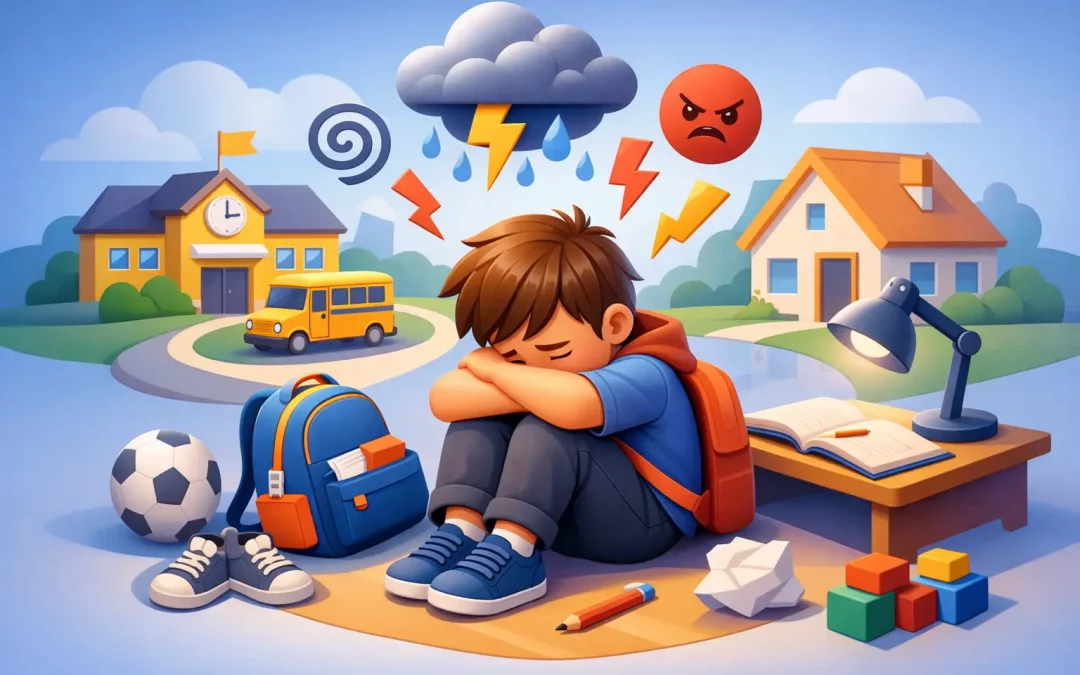
The backpack hits the floor. A simple question like, “How was school?” gets a sharp answer, tears, silence, or a full-blown argument over the wrong snack. If you have been wondering what causes after school meltdowns, the answer is usually not that your child is trying to make the evening hard. More often, they have reached the end of what their nervous system can manage.
This can be especially confusing when school reports that your child had a good day. They held it together there, then fall apart with you. That does not mean they were faking it at school or saving their worst behavior for home. It often means home is where they finally feel safe enough to let go.
What causes after school meltdowns?
A school day asks a lot of a child or teen. They have to wake up on time, move through transitions, follow directions, tolerate noise, manage academic demands, read social situations, wait their turn, and adjust when something does not go as planned. Some young people also work hard to hide anxiety, learning struggles, sensory discomfort, or the feeling that they do not quite fit in.
By dismissal, their internal resources may be nearly gone. A small disappointment can be the final straw, not the true cause of the reaction.
The effort of holding it together
Many children spend the school day using every bit of self-control they have. They may be trying to sit still when their body needs movement, stay quiet in a loud room, understand instructions that feel confusing, or avoid attention from peers. Even children who appear successful and cooperative may be working very hard underneath.
This is sometimes called restraint collapse. The name matters less than the idea: a child can manage for hours, then unravel in the place where they do not have to keep performing. Their meltdown is not proof that you are doing something wrong. It may be evidence that you are their safe place.
Hunger, thirst, fatigue, and sensory overload
Bodies matter. A child who skipped lunch, barely drank water, had poor sleep, or has been surrounded by noise and activity all day has less capacity for frustration. Hunger does not explain every hard afternoon, but it can make ordinary demands feel unbearable.
Sensory overload can look like irritability, wild energy, shutting down, or intense reactions to sounds, clothing, touch, or siblings. The busy ride home, a crowded after-school program, or a parent asking several questions at once can feel like too much input for a system that is already full.
Social stress that stays hidden
A child may not tell you about the awkward lunch period, the friendship shift, the teacher correction, the group project, or the moment they felt embarrassed in class. They may not have words for it yet. Teens especially may say “nothing” because explaining feels exhausting or because they are still sorting out what happened.
Do not assume a meltdown means there is a serious problem at school. But stay curious. Repeated after-school distress can be a clue that something is taking more out of your child than adults can see.
The hard transition from school to home
Transitions are demanding, even when they look routine. School has a clear structure. Home may bring new expectations right away: get in the car, answer questions, start homework, change clothes, go to practice, help with chores, get ready for dinner.
For a dysregulated child, those reasonable requests can arrive as one more demand they cannot handle. The issue is often timing, not the request itself. Homework still matters. Respect still matters. But a nervous system that is overloaded cannot reliably access its best problem-solving skills.
Start with regulation, not correction
When a child is yelling, crying, refusing, or slamming doors, the urge to correct can be powerful. You may be tired too. You may need to leave for practice, make dinner, care for other children, or protect your own limits. Those realities are real.
Still, the most useful first question is not, “How do I stop this?” Try, “What is this behavior telling me about what they need right now?” The answer may be food, quiet, movement, space, connection, predictability, or help with a problem they cannot yet name.
At Anchor Point, we use a simple sequence: Notice, Regulate, Respond, Repair. It gives adults something steady to return to when the moment gets loud.
Notice the pattern without blaming
Look for what happens before the meltdown. Does it occur on days with sports, tests, bus rides, or substitute teachers? Is it worse when your child has not eaten? Does it start when homework comes up, or before you even get home?
You are not building a case against your child. You are gathering information. A short note in your phone for a week or two can reveal patterns that are hard to see in the middle of daily life.
Regulate yourself first
Your calm does not have to be perfect. It just needs to be steadier than the storm. Lower your voice, loosen your shoulders, and use fewer words. If you feel your own frustration rising, take one slow breath before responding.
You might say, “You are having a really hard landing after school. You are safe. We can talk later.” Or, “I am not going to argue with you right now. Let’s get your body settled first.”
This is not giving in. It is choosing not to turn an overloaded moment into a power struggle.
Respond to the need in front of you
A helpful after-school routine is less about strict rules and more about creating a predictable landing zone. Some children need a snack and 20 quiet minutes. Others need to move, talk in the car, listen to music, or sit close without talking. Teenagers may need privacy before they can reconnect.
Offer limited choices when you can: “Do you want a snack in the car or when we get home?” “Do you want quiet, music, or a quick walk with me?” Choices can return a small sense of control without placing the full burden of decision-making on a tired child.
Try to delay nonurgent demands. If possible, do not lead with questions, homework reminders, consequences, or a rundown of the evening schedule. There will be time to address responsibilities once your child is more settled. If the schedule truly cannot wait, name that plainly: “We have ten minutes before we leave. First snack, then shoes. I will help you get there.”
Repair after the storm
Regulation does not mean ignoring hurtful behavior. It means waiting until teaching can actually land. Later, when everyone is calmer, return to what happened.
Keep it simple: “That was a tough afternoon. I think your body was overloaded, and yelling at me still hurt. What could help next time when you walk in the door?” You can also own your part: “I raised my voice. I am sorry. I want to handle that differently.”
Repair teaches something punishment alone cannot: hard moments do not have to break connection. They can become a place to practice honesty, boundaries, and a better plan.
When after-school meltdowns need more support
Frequent meltdowns do not automatically mean something is seriously wrong. They do deserve attention when they are intense, getting worse, affecting sleep or school attendance, involving aggression or safety concerns, or leaving your child unable to recover for long periods.
Bring your observations to a pediatrician, school counselor, therapist, or another qualified support person. Specific examples are more useful than labels. Share what happens, when it happens, what seems to make it worse, and what helps even a little. A child may need support for anxiety, learning differences, sensory needs, friendship stress, sleep problems, or something else entirely.
You do not have to solve every after-school meltdown in one week. Start by making the first 20 to 30 minutes after school a little less demanding and a little more predictable. Notice what changes. A calmer landing will not erase every hard day, but it can tell your child something powerful: you do not have to hold it all together alone.
 English (United States)
  English (UK)