
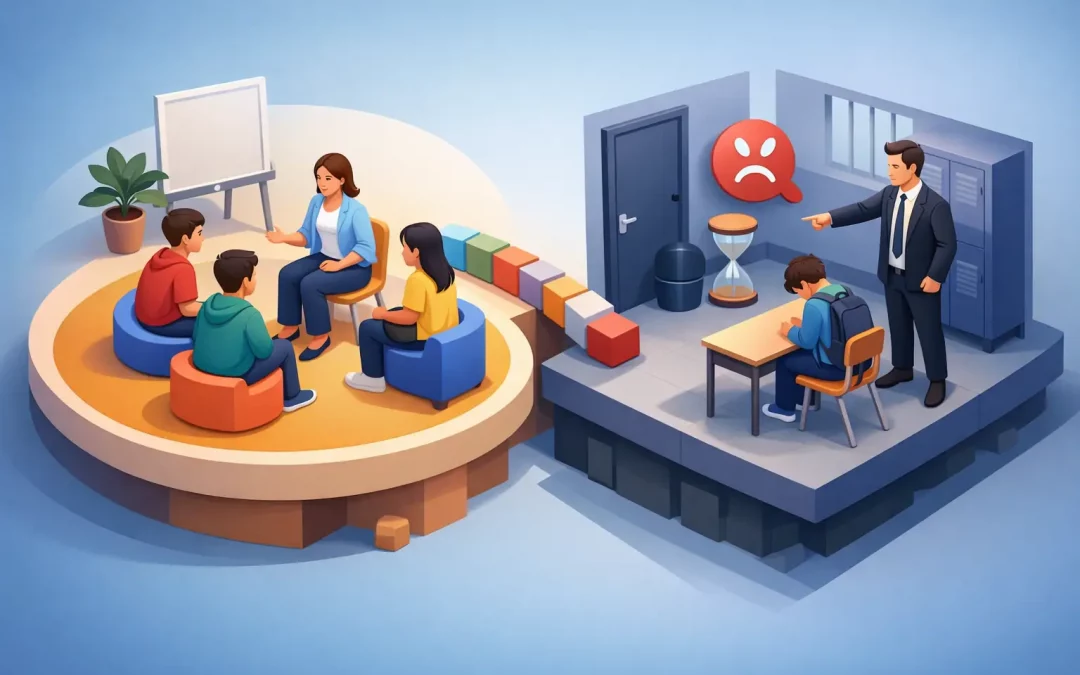
A student shoves another child at recess. A teen screams, slams a door, and breaks something at home. An adult needs to act. The question is not whether the behavior matters. It does. The question in restorative practices versus punishment is what response will create safety now while also helping a young person do better next time.
When adults are exhausted, punishment can feel clear and immediate. Send them out. Take the phone. Give detention. Ground them. Sometimes a consequence is necessary, especially when someone has been hurt or safety has been compromised. But consequences alone do not teach the skills a dysregulated child or teen did not have access to in that moment.
Restorative practice offers another path. It holds the line on harm while making room for regulation, responsibility, and repair. It asks, “What happened? Who was affected? What needs to happen now to make things as right as possible?” That is not being permissive. It is teaching accountability in a way that can actually stick.
What punishment is trying to accomplish
Punishment usually aims to stop unwanted behavior by adding discomfort or taking something away. It may bring short-term compliance. A child may stop yelling because they lose screen time. A student may sit quietly because they fear another referral.
But fear, shame, and isolation can also push the real problem underground. A young person may learn to hide mistakes, lie to avoid consequences, or blame someone else. They may not learn how to notice the early signs of anger, ask for space, handle disappointment, or repair a relationship after causing harm.
This does not mean every punishment is damaging or that adults who use it are failing. Most adults reach for what they were taught, what their workplace expects, or what feels possible in a hard moment. When your nervous system is activated too, a quick consequence can seem like the only move.
The limitation is that punishment often focuses on control after the fact. It may answer, “How do I make this stop?” without answering, “What was this behavior communicating, and what skill or support is missing?”
How restorative practices versus punishment differ
The clearest difference is not whether there is a consequence. It is the purpose of the response.
A punitive response centers on making the young person experience a loss or discomfort because they broke a rule. A restorative response centers on safety, impact, responsibility, and repair. It still has limits. It may still include losing access to something temporarily, changing a plan, or taking space from others. But those limits are connected to what happened and paired with teaching.
For example, if a child throws a classroom supply during an argument, a punishment might be an automatic detention. A restorative response begins by making the area safe and helping the child settle enough to talk. Later, the adult might say, “The scissors were not safe to throw. Someone could have been hurt. You need to help restore the space and we need a plan for what you can do when you feel that mad again.”
The child may clean up the materials, check on anyone affected, practice asking for a break, and have closer support during the next difficult activity. That is accountability. The child is not excused from the harm. They are being shown how to take responsibility for it.
Regulation comes before a useful conversation
A child in full meltdown cannot calmly explain their choices. A teen whose body is flooded with stress may hear even a reasonable question as an attack. In those moments, pushing for an apology, explanation, or lesson can turn a hard moment into a power struggle.
Start with Notice, Regulate, Respond, Repair.
Notice what is happening underneath
Notice the behavior, but also look for the stress beneath it. Is this child overwhelmed, embarrassed, hungry, afraid, grieving, overstimulated, or feeling cornered? Is this pattern showing up during transitions, academic demands, sibling conflict, or unstructured time?
Behavior is communication, even when the message comes out badly. “I hate you” may mean “I feel powerless.” Refusal may mean “I do not know how to do this without failing.” This does not make hurtful behavior okay. It gives you a more useful starting point.
Regulate yourself first
Your calm is not a reward for good behavior. It is a tool for keeping the situation from growing bigger.
Take one breath before you speak. Lower your voice. Use fewer words. If you need a moment, it is okay to say, “I am going to take a breath so I can help with this.” If another adult is available, trade places before frustration takes over.
You do not need to be perfectly calm. You just need to avoid adding more heat. A steady adult helps a young person borrow enough calm to regain control.
Respond with safety and a clear limit
During the peak of distress, focus on what must happen right now. “I will not let you hit.” “Move back two steps.” “The conversation can continue when voices are lower.” “You can sit here or take space in the hallway with me.”
These statements are firm without being shaming. They do not argue about intent. They do not require a child to agree with you before safety is restored.
If there is immediate danger, get help, separate people, remove unsafe items, and follow the safety procedures available to you. Restorative practice never means leaving others unprotected while waiting for a child to calm down.
Repair after the storm
Repair happens later, when everyone can think more clearly. Keep the conversation simple and specific. Ask what happened from the young person’s point of view. Name the impact without labeling them as bad. Then ask what could help repair the harm.
A repair might include a genuine apology, cleaning or replacing something damaged, checking on someone who was hurt, completing missed work, or practicing a different response with an adult. Not every harmed person will be ready to talk, and they should not be pressured to forgive. Repair respects their needs, too.
The final piece is planning. “What will you notice in your body next time?” “Who can you ask for help?” “What words can you use instead of throwing or leaving?” A plan should be small enough to use when stress is high.
Restorative does not mean no consequences
This is where many adults get stuck. They worry that a restorative approach lets a child off the hook. It does not.
A meaningful consequence can be part of repair when it is related, reasonable, and respectful. If a teen uses a phone to harass someone, limiting phone access while they participate in repair may make sense. If a student repeatedly damages equipment, they may need increased supervision and may lose independent access to it for a time.
The difference is that the adult explains the connection. “You are not using the phone privately right now because it was used to hurt someone. We will revisit this after we have addressed the harm and made a safer plan.” The goal is safety and learning, not making the teen suffer long enough to prove a point.
Some situations also require formal school discipline, mandated reporting, or outside support. Serious threats, violence, repeated harassment, and unsafe behavior need clear procedures. Restorative conversations should not replace protection, investigation, or appropriate accountability. They can, however, be part of the path forward once safety has been addressed.
A practical shift for adults
You do not have to become a conflict-resolution expert overnight. Begin by changing one question after a hard moment. Instead of asking only, “What consequence does this child deserve?” ask, “What does safety require, what harm needs repair, and what support will make a different choice more likely?”
That question creates room for both boundaries and compassion. It also reduces the pressure to find a perfect response while everyone is upset.
Children and teens need adults who can say, “This behavior is not okay,” without sending the message, “You are not okay.” They need to learn that mistakes have impact, relationships can be repaired, and strong feelings do not have to control their next choice.
That kind of learning takes time. There will be days when the conversation does not go smoothly and the plan does not work. Still, every calm limit, every repaired rupture, and every chance to try again helps build the skills and trust young people carry forward.
 English (United States)
  English (UK)