
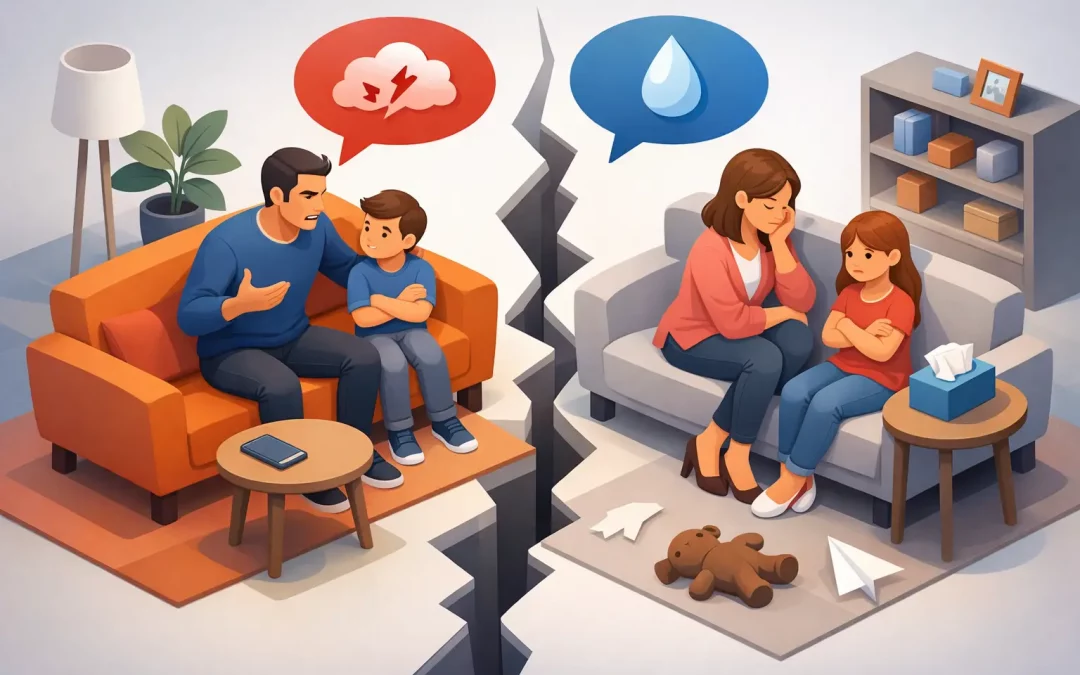
A slammed door, a sharp comment, a child who suddenly will not speak – family conflict rarely arrives when anyone feels rested and ready. In those moments, a family conflict communication guide is not about finding perfect words. It is about helping the adults in the room become steady enough to make the next helpful choice.
When a young person is overwhelmed, their behavior may look rude, defiant, dramatic, or impossible to reason with. But behavior is communication. Under the argument may be embarrassment, fear, disappointment, a need for more control, or a nervous system that has gone into overload. You do not have to approve of the behavior to get curious about what is underneath it.
The goal is not to win the moment. The goal is to lower the heat, protect safety, and keep the relationship strong enough for learning and repair later.
Why family conflict gets loud so quickly
Conflict is hard because it affects everyone in the home. A teen may hear a simple request as criticism. A parent may hear a slammed door as disrespect. A younger child may melt down because a sibling got attention first. Then the adult’s own stress joins the room.
This is not a sign that you are failing. It is what can happen when several nervous systems are stressed at once.
When a child or teen is dysregulated, the thinking part of their brain is less available. They may argue in circles, insist that nothing is fair, use hurtful language, or refuse every reasonable option. Trying to teach a lesson in that state often creates a power struggle. The more pressure they feel, the more they may push back, shut down, or escalate.
That does not mean there should be no limits. It means connection and regulation need to come before a productive conversation. You can hold a boundary without adding more heat.
A family conflict communication guide for real moments
Anchor Point’s simple framework can help when emotions are rising: Notice, Regulate, Respond, Repair. You do not need to do every part perfectly. Even one steady choice can shift the direction of a hard moment.
Notice what is happening beneath the words
Start by noticing the signals, not just the surface behavior. Is your child pacing, crying, going quiet, yelling, clenching their fists, or repeating the same complaint? Is this conflict happening after school, before bed, during transitions, or after a difficult message from a friend?
Also notice yourself. Is your chest tight? Are you speaking faster or louder? Do you feel an urgent need to make them understand right now? Those signals matter. They are not a reason for shame. They are information that you may need a pause too.
Instead of asking, “Why are you acting like this?” try a quieter observation: “Something feels really big right now.” Or, “I can see you are upset. We do not have to solve this all at once.”
This does not excuse harmful behavior. It simply tells the young person that you see distress before you move to correction.
Regulate before you try to reason
A regulated adult does not mean an adult who feels calm all the time. It means an adult who can slow themselves down enough to avoid making the conflict bigger.
Take one breath before responding. Lower your voice. Unclench your jaw. Put both feet on the floor. If another safe adult is available, trade places for a few minutes. If you need space, say so clearly: “I am getting frustrated, and I want to handle this well. I am going to take five minutes, then I will come back.”
For a child who is escalating, reduce the number of words. Long explanations can feel like more pressure. Try: “You are safe.” “I am here.” “We can talk when voices are lower.” “You do not have to agree with me, but you cannot throw things.”
If there is immediate risk of someone being hurt, safety comes first. Create space, move others away if needed, and get additional support. Communication can wait until everyone is safe enough to have it.
Respond with both warmth and a boundary
Once the intensity drops even a little, respond to the need and the behavior separately. This is where many adults get stuck. They worry that empathy means giving in. It does not.
You can say, “You are really disappointed that screen time is over. I get that. The answer is still no more screens tonight.” Or, “You can be angry with your brother. You cannot call him names. You can tell me what happened, or you can take a break in your room and come back.”
Clear choices are often more helpful than open-ended questions during conflict. A teen who is flooded may not know what they need when asked, “What do you want to do?” A simpler choice gives structure without control: “Do you want to talk in the kitchen or take ten minutes first?”
Be careful with questions that sound like a courtroom. “What were you thinking?” and “How many times do I have to tell you?” may come from understandable frustration, but they usually invite defensiveness. Try asking what happened before asking for accountability. “Walk me through what was going on for you.”
Sometimes a young person will not talk. That can be frustrating, especially when the issue matters. You can leave the door open without chasing them: “You do not have to talk now. We are going to come back to this tonight.” Following through calmly matters more than forcing an answer in the moment.
When the conflict is really about something else
The argument about homework, dishes, curfew, or a sibling’s tone may not be about that single issue. Young people often bring stress home because home is where they feel safest letting it out. A difficult school day, friendship conflict, grief, anxiety, hunger, poor sleep, or a change in routine can make a small request feel unbearable.
This is not a reason to ignore patterns. If conflict happens around the same issue again and again, address the pattern when everyone is calm. Ask what makes that moment hard. Maybe a child needs a snack and quiet time before homework. Maybe a teen needs more warning before a transition. Maybe the household rule is clear, but the plan for meeting it is not.
It depends on the child and the situation. Some young people need more space before they can reconnect. Others need a calm adult nearby. The useful question is not, “What should work for every child?” It is, “What helps this child return to safety and cooperation?”
Repair is where trust grows
A hard moment does not have to define the relationship. Repair teaches children and teens that conflict can be survived, talked about, and made right. It also shows them what accountability looks like without humiliation.
When things are calm, name your part if needed. “I raised my voice earlier. That was not how I wanted to handle it. I am sorry.” This does not weaken your authority. It models the behavior you want your child to learn.
Then return to the boundary and the impact. “It is okay to be angry. It is not okay to throw your backpack at the wall. What can we do next time when you feel that upset?” If an apology or restitution is needed, keep it concrete. A child may need to help clean up, replace something damaged, or check in with a sibling they hurt.
Repair is not a forced speech. Some young people need time before they can apologize or talk. Stay steady. Let them know the relationship is still there and the expectation still matters.
A steadier next step
You will not respond perfectly to every family conflict. No parent, caregiver, teacher, or helping professional does. What matters is having a path back when the moment gets messy: notice the stress, regulate yourself, respond with a clear boundary, and repair what was strained.
Each time you choose calm over control, you give a young person something powerful: the experience of being held accountable without being pushed away. That is how safety grows, one imperfect hard moment at a time.
 English (United States)
  English (UK)