
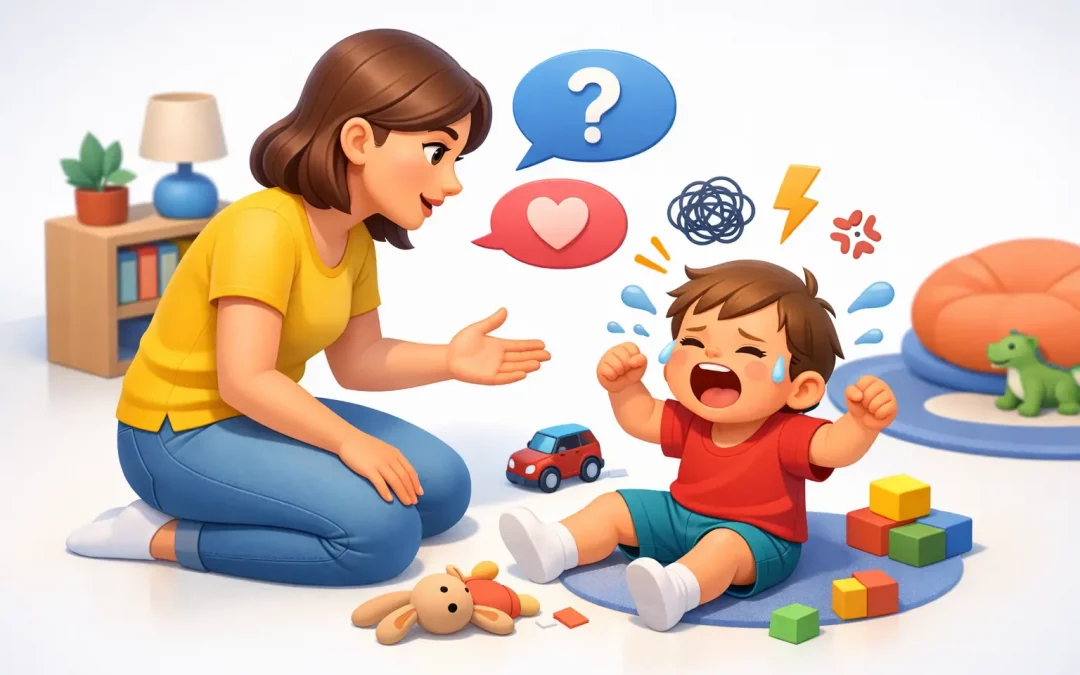
The moment a child starts yelling, kicking, collapsing on the floor, or shouting “No,” most adults feel the same pressure – make it stop. Fast. That urgency is exactly why knowing what to say during a tantrum matters so much. In the heat of the moment, the right words can lower stress. The wrong ones can accidentally turn distress into a power struggle.
A tantrum is not a good time for a lecture, a consequence-heavy speech, or a debate about what “should” be happening. When a child is overwhelmed, their thinking brain is not fully online. They are not sitting there calmly weighing your logic. They are flooded. Behavior is communication, and during a tantrum the message is usually some version of: I am overloaded, I am stuck, I need help, or I do not have the skills for this moment.
That does not mean every tantrum is acceptable. It does mean your first job is not to win. Your first job is to help bring the temperature down.
What to say during a tantrum starts with regulation
Before you speak to the child, notice what is happening in your own body. If your chest is tight, your jaw is clenched, and your voice is rising, the child will feel that. Kids borrow calm from regulated adults. They also react to adult stress very quickly.
This is where a simple framework helps: Notice, Regulate, Respond, Repair.
Notice what is happening. Regulate yourself enough to stay steady. Then respond with short, clear language. Repair later if the moment got messy.
During the tantrum itself, less is usually more. Long explanations often add fuel because they require the child to process more than they can handle. A calm voice, a few steady phrases, and clear limits are more effective than a long speech.
The most helpful things to say during a tantrum
What you say should do one of three things: help the child feel safe, show that you understand the feeling, or set a calm limit. Ideally, it does more than one at the same time.
You might say, “You’re really upset. I’m here.” That works because it names the distress without arguing with it. It also communicates presence. A dysregulated child often needs your steadiness more than your solution.
You might say, “I won’t let you hit. I’m going to help keep everyone safe.” This matters when the behavior is unsafe. It is calm, firm, and clear. It does not shame the child, but it does protect people.
You might say, “You wanted that, and it’s hard to hear no.” This is especially helpful when the tantrum started after a limit. You are not changing the limit. You are showing understanding. Feeling understood often reduces intensity faster than being corrected.
Other useful phrases include, “You don’t have to do this alone,” “I can help when you’re ready,” “Your body is having a hard time,” and “Let’s get through this first.” These phrases work because they lower pressure. They do not demand instant self-control from a child who does not currently have it.
What not to say during a tantrum
Some phrases are common because adults are stressed, embarrassed, or desperate. That makes sense. But certain responses tend to escalate rather than settle.
“Calm down” is one of them. It sounds simple, but a flooded child usually cannot just calm down because they were told to. The phrase often lands as pressure or dismissal.
“So stop crying” and “You’re fine” can also backfire. Even if the trigger seems small to you, the child’s nervous system is telling a different story. Minimizing the feeling does not make it smaller. It usually makes the child feel more alone inside it.
Threats often make things worse too. “If you don’t stop right now, then…” may get compliance sometimes, especially if a child is scared of consequences, but it does not build regulation. It shifts the moment into fear, control, and often more reactivity.
The same goes for reasoning too early. “You know better than this,” “We talked about this,” or “Use your words” might all be true, but in the middle of a tantrum they are often mistimed. Teaching works better after the storm, not in the center of it.
When the child is very young
With toddlers and preschoolers, your words should be especially short and concrete. A young child in a tantrum cannot track much language. Think one sentence, maybe two.
Try: “You’re mad. I’m here.” Or, “No more cookies. You’re upset.” Or, “I won’t let you throw that.” Then stop talking for a moment.
This can feel too simple, especially if you are used to explaining. But simple is often what helps. Young children need co-regulation more than discussion. Your tone, face, pace, and body position matter as much as the words.
If the child wants closeness, offer it. If they need space, stay nearby without crowding. It depends on the child. Some settle faster with a quiet adult beside them. Others need a little room before they can accept comfort.
What to say during a tantrum at school or in public
Public tantrums can spike adult stress fast. There is often an extra layer of embarrassment or pressure from other people watching. That pressure can tempt adults to get louder, stricter, or more controlling. Usually, that makes the moment harder.
In public, keep your language even more focused. “You’re overwhelmed. I’m helping.” “We’re going somewhere quieter.” “I won’t let you run.” “We can talk when your body is calmer.”
At school, the same principle applies. A student in full distress is not being helped by a public correction. Short, private, low-demand language usually works better. “I can see this is a hard moment.” “You’re safe.” “Let’s step over here.” “I’ll stay with you.”
The goal is not to reward the tantrum. The goal is to reduce stimulation and restore enough regulation for the child to rejoin, recover, or communicate.
When a tantrum looks more intentional
Sometimes adults say, “But what if they are doing this to get their way?” Real life is messy, and yes, children can learn that big behavior gets a big response. But even then, a dysregulated moment still needs a regulated adult.
You do not have to choose between empathy and boundaries. You can hold both. “You really want me to change my mind. I’m not changing my mind.” “I hear that you’re mad. The answer is still no.” “I can help you through this, but I’m not giving in.”
That is different from arguing. Arguing invites the child to keep climbing. Calm repetition sends a steadier message. It says: I see your distress, and I am not adding more chaos.
After the tantrum, the words change
Once the child is calmer, that is when problem-solving can begin. This is the repair part, and it matters. Not because you need a perfect processing conversation every time, but because kids learn best when they are regulated enough to reflect.
You might say, “That was a hard moment. What happened right before you got so upset?” Or, “Your body got really overwhelmed. Let’s figure out what might help next time.” Or, “It’s okay to be angry. It’s not okay to hit. Let’s make a plan for what to do instead.”
This is also the time to repair your side if needed. If you snapped, got too sharp, or mishandled the moment, you can say, “I was feeling stressed and I raised my voice. I’m sorry. I want to handle that better.” That does not weaken your authority. It strengthens trust.
At Anchor Point Calm in the Storm, this is the heart of the work – helping adults respond in a way that protects both safety and relationship.
If you can only remember one thing
If your mind goes blank in hard moments, keep one sentence ready: “You’re having a hard time. I’m here. I’ll help keep this safe.” That one line covers connection, presence, and boundaries.
You do not need perfect words. You need regulated enough words. A calm tone. A short phrase. A clear limit. Then time.
Tantrums can feel loud, personal, and exhausting. But underneath them is usually a child who is overwhelmed, not a child who needs you to overpower them. When you respond with steadiness instead of shame, you make it more likely that the child will recover, learn, and trust you again after the storm passes.
 English (UK)
  English (United States)