
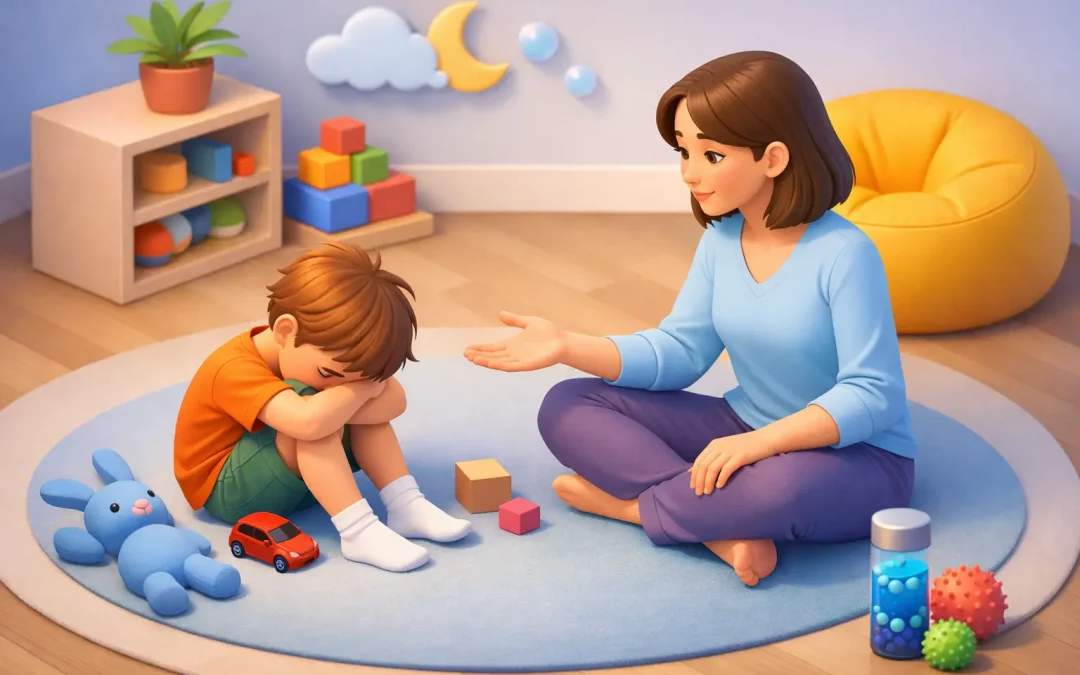
When a child is yelling, shutting down, refusing, crying hard, or saying hurtful things, it can feel personal. It can also feel urgent. Knowing how to support child dysregulation begins with one grounding truth: a dysregulated child is having a hard time, not trying to give you a hard time.
That does not mean every behavior is acceptable. It means the path to safer behavior is rarely found through more pressure, louder consequences, or a power struggle. In the moment, children and teens need an adult who can see what is happening underneath the behavior and offer enough steadiness for their nervous system to begin settling.
You do not have to be perfectly calm to do this well. You only need a next step.
What child dysregulation can look like
Dysregulation is what happens when a child’s stress response takes over. Their thinking brain is less available, and their body is focused on fighting, fleeing, freezing, or protecting itself. What you see on the outside may look like defiance, disrespect, avoidance, aggression, tears, silence, or nonstop talking.
A younger child may throw a shoe because it is time to leave the park. A teenager may slam a door and say they do not care after a hard day at school. A student may put their head down, refuse work, or leave the classroom. Different behavior, same basic need: their system is overloaded.
The trigger may be obvious, like being told no. Sometimes it is not. Hunger, exhaustion, sensory overload, conflict, shame, a change in plans, learning stress, grief, worry, or feeling misunderstood can all stack up. The final behavior is often the last drop, not the whole story.
How to support child dysregulation in the moment
Anchor Point uses a simple sequence: Notice, Regulate, Respond, Repair. You do not need to do each part perfectly. The framework gives you something to return to when your own stress is rising.
Notice what is happening underneath
Start by naming the moment to yourself without adding a harsh story. Instead of thinking, They are being impossible, try: They are overwhelmed. Instead of, They are trying to control me, try: Something about this feels unsafe, unfair, too big, or out of control to them.
This shift matters because the story you tell yourself shapes your next move. If you see defiance, you may try to win. If you see dysregulation, you can focus on safety, limits, and support.
Notice your own signals, too. Tight shoulders, a raised voice, the urge to lecture, and the need to make the behavior stop immediately are signs that you may need a pause. Adults do not cause every hard moment, but adult regulation strongly influences whether a moment grows or settles.
Regulate yourself before asking the child to regulate
Children borrow calm from the adults around them. That does not mean you should fake a cheerful voice while you are boiling inside. It means slowing your body enough to choose your response.
Take one breath that is longer on the exhale. Lower your voice. Unclench your jaw. Put both feet on the floor. If another safe adult is available, tag out for a few minutes.
You might say, I am going to take a breath so I can help. Or, I am here. We can talk when our bodies are a little calmer.
This is not giving in. It is creating the conditions where learning and problem-solving are possible. A child who feels cornered is more likely to escalate. A child who feels safely contained is more likely to come back online.
Respond with fewer words and clear limits
During dysregulation, long explanations often land like more noise. Keep your language short, calm, and concrete. You can validate the feeling without agreeing to unsafe behavior.
Try phrases like: I can see this is really hard. You do not have to like this limit. I will not let you hit. I am going to give you space, and I am staying nearby. We can figure out the next step when you are ready.
The limit should be clear and doable. If a child is throwing objects, move breakable items, increase physical space, and say, I will keep everyone safe. If a teen is shouting, you might say, I want to hear you. I will talk when we can both use voices that are safe enough for this room.
Avoid asking big questions in the peak of the storm. Why did you do that? and What is wrong with you? usually increase shame or invite an argument. Save the detective work for later.
Match your support to the child and the setting
There is no single response that works for every child. Some children settle with quiet closeness. Others need space, movement, water, a snack, music, or a simple task for their hands. A child with a history of trauma may need extra predictability and physical distance. A teen may respond better to side-by-side conversation than direct eye contact.
At home, you may be able to reduce demands and offer a reset. In a classroom, the immediate goal may be helping the student get to a quieter space without public shame. In either setting, the priority is the same: lower the stress enough to make the next safe choice possible.
Choice can help when it is genuine and limited. You might say, Do you want to sit on the porch or in the car for two minutes? Would you like water or a cold washcloth? Do you want me close by or a little farther away? Do not offer choices you cannot honor, and do not turn choices into a negotiation during a safety issue.
When safety is the concern
Calm support does not mean tolerating harm. If a child is at risk of hurting themselves or someone else, focus first on immediate safety. Move other children away, remove nearby dangerous objects if you can do so safely, and use as little physical intervention as possible.
Get additional help right away when there is an immediate risk of serious injury, a weapon, threats of suicide, severe self-harm, or behavior you cannot safely manage. Follow your school, agency, or family safety plan, and contact emergency or crisis support when needed. You are not failing by asking for help. Safety is a shared responsibility.
Repair after the storm
The most useful conversation usually happens after bodies have settled. Repair is not a reward for the child calming down. It is how trust grows and how children learn that difficult moments do not have to define the relationship.
Keep the first repair conversation simple. You might say, That was a really big moment. I am glad we got through it. What was happening for you right before things got so hard? Then listen for what they can tell you, even if the answer is small or incomplete.
You can also own your part without taking responsibility for everything. I raised my voice, and that did not help. I am sorry. Next time I will try to take a pause sooner. This teaches a powerful lesson: people can make mistakes, repair harm, and try again.
Once connection is back, address the behavior and make a plan. If a child threw a toy, they may help clean it up or repair what they can. If a teen sent a hurtful message, talk about what repair could look like. Consequences work best when they are connected, respectful, and delivered after regulation, not as punishment in the heat of the moment.
Build support before the next hard moment
Repeated dysregulation is information. Look for patterns without turning your child into a problem to solve. Notice when hard moments happen, what comes before them, what helps, and what makes things worse. A few notes can reveal that mornings, transitions, homework, hunger, certain classes, or sibling conflict are common pressure points.
Small supports can prevent more than big speeches. This may mean a snack before errands, a visual plan for transitions, a five-minute warning, a regular check-in after school, or a calm-down space that is not used as punishment. For some children, additional support from a pediatrician, therapist, school counselor, or other qualified professional can be an important part of the plan.
You are allowed to need support, too. Caring for a dysregulated child can be exhausting, especially when the hard moments are frequent or intense. Tools help. A plan helps. Another steady adult helps.
The goal is not a child who never struggles. The goal is a child who gradually learns, through repeated safe experiences, that big feelings can be carried, behavior can be repaired, and they do not have to face the storm alone.
 English (UK)
  English (United States)