
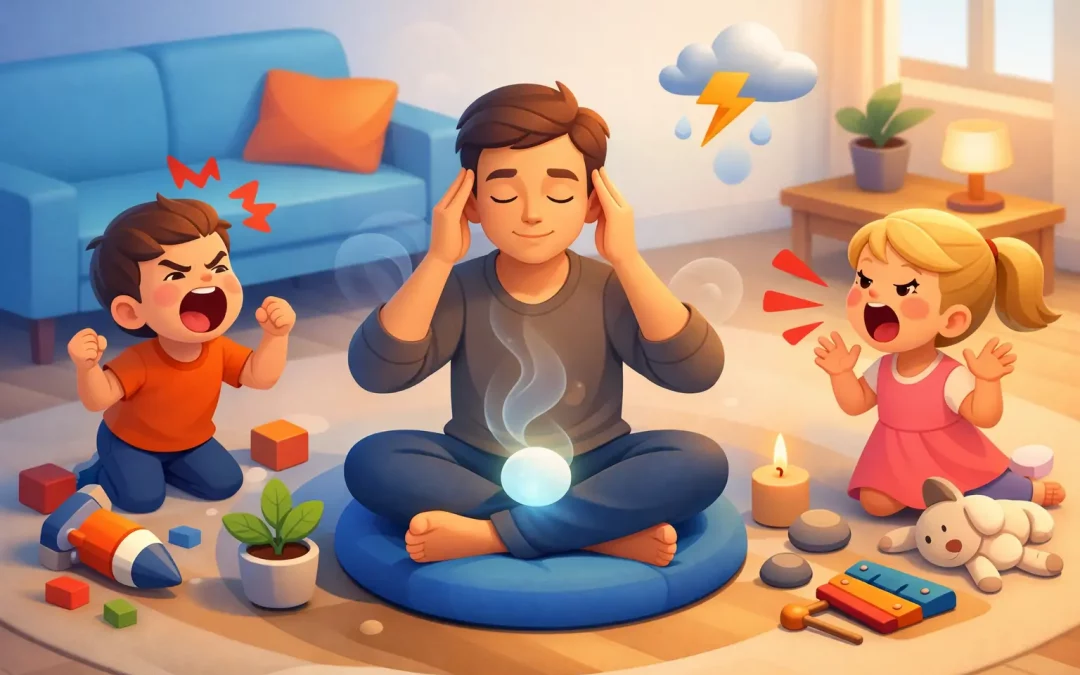
The yelling usually hits fast. A slammed door, a sharp “No,” a scream from the back seat, a child yelling in your face while your own body floods with heat. If you have ever wondered how to stay regulated when kids yell, you are not failing. You are having a nervous system response to stress, noise, and perceived threat.
That matters, because most adults are not struggling from a lack of love. They are struggling because yelling pulls them out of the thinking part of the brain and into survival mode. Once that happens, it gets much harder to stay clear, steady, and connected.
The goal is not to become a perfectly calm robot. The goal is to notice what is happening in you early enough that you can slow the cycle instead of adding fuel to it. That is where regulation starts.
Why kids’ yelling hits adults so hard
Yelling is more than sound. It can feel like disrespect, rejection, danger, chaos, or loss of control. For some adults, it also wakes up old memories from their own childhood, past relationships, or stressful work environments. Even when you know a child is overwhelmed, your body may still react like you are under attack.
That is why shame is not helpful here. If your heart pounds, your jaw tightens, or you feel the urge to yell back, that does not mean you are a bad parent, teacher, or caregiver. It means your system got activated.
Kids yell for different reasons. Sometimes they are angry. Sometimes they are overloaded, scared, embarrassed, tired, or stuck. Sometimes they do want power in the moment. But even then, the yelling is still communication. It tells you the child does not have access to calm, organized problem-solving right now.
When you see yelling only as defiance, you are more likely to move toward control. When you see it as dysregulation, you are more likely to move toward steadiness. That shift does not excuse harmful behavior. It just helps you respond in a way that works better.
How to stay regulated when kids yell in real time
Start with Notice. Before you manage the child, notice yourself. Ask, What is happening in my body right now? You may not have time for a deep reflection, but you can catch the basics. Is your voice getting louder? Are your shoulders up? Are you talking too fast? Do you feel the urge to lecture, threaten, or win?
That quick check matters because escalation often starts in the adult body before it shows up in adult words.
Next comes Regulate. This is the part many adults skip because it feels too simple. But simple is exactly what works in a heated moment. Plant your feet. Unclench your hands. Drop your shoulders. Exhale longer than you inhale. If you can, let one breath be slow enough that your body gets the message: I do not have to fight this second.
You do not need to look perfectly composed. You just need to reduce your own intensity by a few degrees. A small drop in your stress level can change the whole interaction.
Then Respond. Keep your words short. Yelling brains do not process long explanations well. Try calm, clear language like, “I’m listening. I’m not going to yell with you.” Or, “You’re really upset. I’m going to help us get through this.” If safety is the issue, be direct: “I won’t let you hit. I’m moving back.”
Short sentences protect everyone better than long speeches. When kids are dysregulated, too many words can feel like pressure.
Later comes Repair. If the moment was messy, repair is still available. You can say, “That was hard. I wish I had used a calmer voice.” Or, “You were really overwhelmed. Let’s figure out what happened.” Repair does not erase limits. It rebuilds safety after stress.
What regulation actually looks like
A regulated adult is not an adult who feels nothing. Regulation means you can feel activated and still choose your next move with some intention.
Sometimes regulation looks like lowering your voice instead of matching the child’s volume. Sometimes it looks like saying less. Sometimes it means taking one step back so your body does not read the child’s yelling as a direct physical threat. Sometimes it means calling another adult in because you know your capacity is gone.
It is also important to say this clearly: staying regulated does not mean allowing verbal aggression without boundaries. You can be calm and still be firm. You can say, “I’m here to help, and I won’t stay in the room if I’m being screamed at.” You can move a class, pause a conversation, or end an interaction temporarily if that is what safety and stability require.
Calm is not passive. Calm is organized.
When your own trigger history gets pulled in
For many adults, the hardest part of learning how to stay regulated when kids yell is that the moment is not just about the moment. A child’s tone, words, or intensity can hook something older in you.
Maybe yelling meant danger in the home where you grew up. Maybe being spoken to sharply makes you feel small, cornered, or powerless. Maybe public yelling brings instant embarrassment and panic. If that is true for you, you are not overreacting on purpose. Your nervous system is connecting present stress with past stress.
This is where preparation helps. If you already know yelling is a trigger, decide on two or three regulation actions before the next hard moment. Keep them realistic. One slow exhale. One phrase you can borrow, like “This is hard, and I can stay steady.” One physical action, like pressing your feet into the ground or loosening your jaw.
You do not need a perfect plan. You need a repeatable one.
What to say when kids yell
Language can either raise the temperature or lower it. Try to avoid questions that sound like cross-examination, like “Why are you acting like this?” or “What is wrong with you?” In a heated moment, those usually create more shutdown or more yelling.
Instead, use language that signals safety and structure. “You’re upset.” “I’m here.” “We’re going to slow this down.” “I’ll talk when voices are lower.” “You don’t have to like the limit. The limit is still the limit.”
That last part matters. Co-regulation is not giving in. It is helping a child borrow your steadiness while you hold the boundary.
If the child is younger, your tone and body language will do even more work than your words. If the child is older, respect matters deeply. Teens especially will escalate fast if they feel trapped, talked down to, or publicly corrected. You can be clear without being shaming.
When you do yell back
Many caring adults do. Stress, exhaustion, sensory overload, and repeated conflict can push anyone past their best intentions.
If that happens, skip the spiral of self-attack. Shame usually makes the next moment worse, not better. Take responsibility, regulate, and repair. That may sound like, “I yelled, and that was not helpful. I’m going to reset and try again.”
Then get curious later. What made that moment so hard? Were you already overloaded? Was it the noise, the disrespect, the audience, the time pressure, the sibling dynamic, the fifth hard behavior of the day? Specific patterns give you something usable. Vague guilt does not.
This is one reason the Notice, Regulate, Respond, Repair framework is so helpful. It gives you a way back, even after a rough moment. At Anchor Point Calm in the Storm, that return to steadiness is part of the work, not proof that you failed.
Build regulation before the next yelling moment
Real-time skills matter, but they work better when your baseline stress is not maxed out every day. That does not mean you need a full wellness routine. It means your nervous system needs enough support that it is not constantly one step from overload.
Look for the pressure points that make yelling harder to handle. Lack of sleep, no transition time, constant noise, hunger, decision fatigue, and carrying too much alone all lower your capacity. If you can reduce even one of those, your response window gets wider.
It also helps to practice calm language when nothing is on fire. Adults often freeze in the moment because they are trying to invent words under stress. Borrow a few simple lines now. Repeat them enough that they become easier to reach.
And remember this: some kids yell more when they feel unsafe, cornered, rushed, or powerless. That does not mean you caused it. It does mean prevention is often relational. Predictable routines, clear limits, respectful correction, and repair after conflict all make yelling less likely over time.
You are allowed to be affected by a child’s yelling. You are also capable of becoming steadier inside it. Not all at once. Not perfectly. But little by little, with practice, awareness, and tools that work in real life.
The next time the volume rises, you do not need to control the whole storm. Just find your footing, lower your own intensity, and be the calm anchor first.
 English (UK)
  English (United States)