
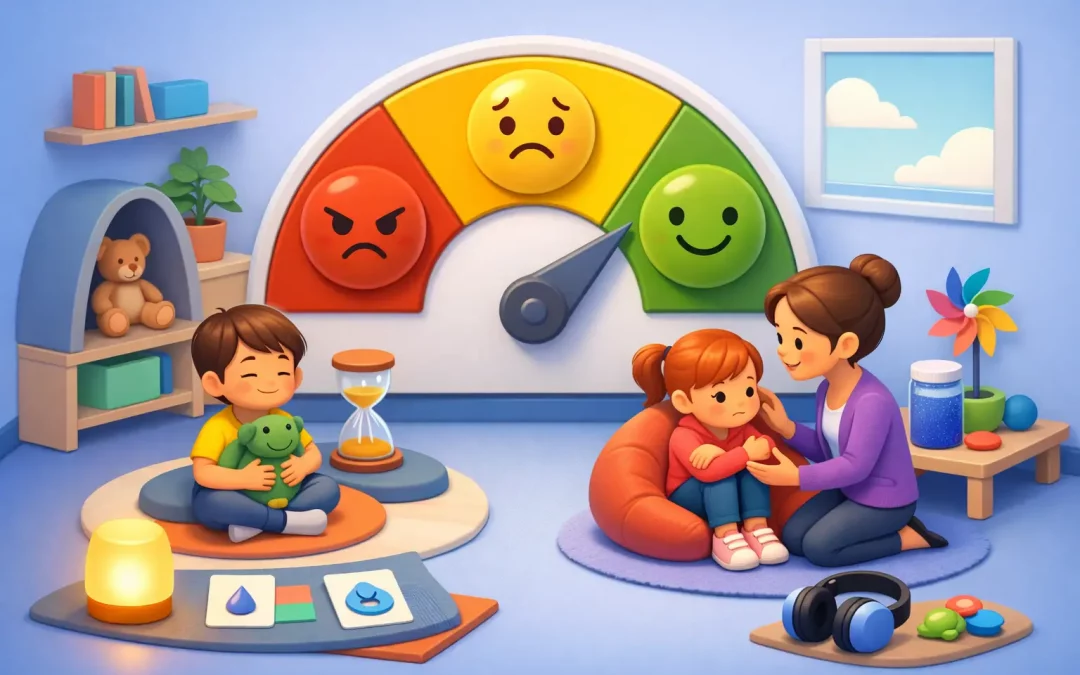
A student puts their head down and refuses to work. Another starts arguing over a small correction. A third leaves the room without permission. In those moments, a classroom regulation guide is not about finding the perfect consequence. It is about helping an overwhelmed nervous system settle enough for learning, problem-solving, and connection to become possible again.
That does not mean letting harmful behavior slide. It means recognizing that a child who is flooded with stress cannot reliably access the skills you are asking for in that moment. When adults lead with calm, clear structure instead of control or a power struggle, they create a safer path back.
What Regulation Means in a Classroom
Regulation is the ability to notice what is happening inside our bodies and emotions, then use support and skills to return to a manageable state. Children and teens are still learning this. Some can recover from frustration with a breath and a reminder. Others need space, movement, fewer words, a predictable adult, or time before they can re-engage.
Dysregulation can look loud: yelling, arguing, throwing materials, refusing directions, or leaving a seat. It can also look quiet: shutting down, staring at a screen, avoiding work, putting a head down, or saying, “I don’t care.” Neither is automatically defiance.
Behavior is communication. It may communicate, “This is too hard,” “I feel embarrassed,” “I do not feel safe,” “I need control,” or “My body is already at its limit.” You do not have to agree with the behavior to get curious about what it is telling you.
The goal is not to excuse every action. The goal is to respond in the order that works: safety and regulation first, teaching and accountability after.
The Classroom Regulation Guide: Notice, Regulate, Respond, Repair
Anchor Point’s simple framework can help when your own stress rises along with a student’s. You do not need a lengthy script. You need a few steady steps you can return to when the room feels hard.
Notice what is happening, without adding a story
Start with observable facts. A student is pacing. Their voice is louder. They ripped up a worksheet. They have not started the assignment after several minutes. Facts keep you grounded. Stories can pull you into assumptions such as, “They are trying to ruin this lesson” or “They do not respect me.”
Then notice the context. Was the work unusually difficult? Did the student just come in from a conflict, a loud hallway, lunch, a test, or a difficult phone call home? Is there a pattern at a particular time of day? A behavior that seems sudden often has a buildup you could not see.
Also notice yourself. Is your jaw tight? Is your voice getting sharper? Do you feel pressure to make the behavior stop immediately because other students are watching? These reactions are understandable. They are also useful information. Your regulated presence is one of the strongest tools available in the room.
Regulate yourself before trying to regulate the student
This step can be brief. Put both feet on the floor. Lower your shoulders. Slow your exhale. Use fewer words. Speak more quietly than the student, not louder. Remind yourself: “This is a hard moment, not a personal attack.”
You are not expected to be perfectly calm. You are human, and classrooms can be demanding. The aim is to be steady enough that you do not add fuel to the moment.
Sometimes regulation means getting support. A planned call to a colleague, counselor, administrator, or behavior support staff member can protect everyone. Asking for help is not a failure of classroom management. It is a thoughtful response when one adult cannot safely hold the whole situation alone.
Respond with safety, choice, and clear limits
Once you are grounded, respond to the need in front of you. A dysregulated student does not need a lecture, a public debate, or five repeated directions. They need calm structure.
Try brief language such as: “I can see this feels like too much right now.” “You are not in trouble for needing a minute.” “I will help you, and I will not let you throw things.” “You can take a two-minute reset at your seat or use the calm space. Which works better?”
Choices are helpful when they are real, small, and acceptable to you. “Do you want to start with number one or work with me at the back table?” is more useful than, “Do you want to do your work?” The student may not be ready to complete everything, but they can often make one manageable decision.
Keep limits simple. “You can be angry. You cannot call people names.” “You can take space. You cannot leave the building.” “I will talk with you when voices are lower.” A limit is not a threat. It is a calm statement of what you will do to maintain safety.
If a student’s behavior creates an immediate risk of harm, follow your school’s safety procedures and bring in support. Regulation-based practice does not mean handling a serious crisis alone or ignoring danger. It means responding without humiliation whenever possible.
Repair after the hard moment
Repair is where trust and learning grow. It should happen after the student has settled, not while they are still flooded. The conversation may take two minutes, or it may need to wait until later in the day.
Start with curiosity: “What was going on for you when the assignment started?” “What did you need that you did not know how to ask for?” “What could help next time?” Then name the impact with care: “When the chair was thrown, people felt unsafe. We need to make that right.”
Repair may include apologizing, helping restore a disrupted space, checking in with someone affected, practicing a different phrase, or making a plan for the next trigger. It is not about forcing shame. It is about building responsibility alongside belonging.
Adults can repair, too. If your tone was harsh, say so plainly: “I was frustrated, and I spoke too sharply. I am sorry. The limit still matters, and I want to handle it better with you.” This does not weaken your authority. It shows students what accountability looks like.
Build Regulation Into the Day Before Things Escalate
A calm classroom is not one where no one struggles. It is one where students know what happens when they do. Predictability lowers stress because students do not have to guess how adults will respond.
Begin by making transitions more visible. Give a short warning before changes. Put the first step of an assignment where students can see it. Offer a quiet way to request help or a break. Normalize movement, water, sensory tools, and brief resets when they support learning rather than becoming an escape from every demand.
It also helps to identify a reset plan with students when they are calm. Where can they go? How long is the break? How will they return? What words or signal can they use before they reach a breaking point? A reset space should not feel like exile or punishment. It is a place to regain enough control to rejoin the group.
There is a trade-off here. Too much flexibility without structure can feel uncertain, especially for students who need clear expectations. Too much structure without room for individual needs can create unnecessary battles. The balance is consistent boundaries with flexible pathways back to participation.
When the Same Behavior Keeps Happening
Repeated behavior is a signal to look beyond the moment. Instead of asking only, “What consequence will stop this?” ask, “What is this student practicing, avoiding, protecting, or asking for?”
Look for patterns across tasks, peers, times, environments, and adult interactions. A student who regularly explodes during writing may need academic support, not just a behavior reminder. A student who argues after correction may be carrying shame or expecting rejection. A student who leaves class may need a planned exit-and-return routine before leaving becomes their only coping skill.
Talk with the student when possible. Their answer may be incomplete, defensive, or surprising. Listen anyway. Collaborate with families and support staff rather than sending home a list of problems. A shared plan works best when it includes what adults will do differently, not only what the student must do.
Steady Adults Change the Climate
You will not prevent every hard moment. Students bring real stress into school, and teachers carry heavy demands of their own. A classroom regulation guide is not a promise of perfect behavior. It is a way to make the next right move when behavior gets big.
Notice the signal. Regulate yourself. Respond with calm limits and practical support. Repair the relationship and the harm afterward. Each time you do, you show students something powerful: hard feelings can be held, mistakes can be addressed, and they do not have to lose connection when they are struggling most.
 English (UK)
  English (United States)