
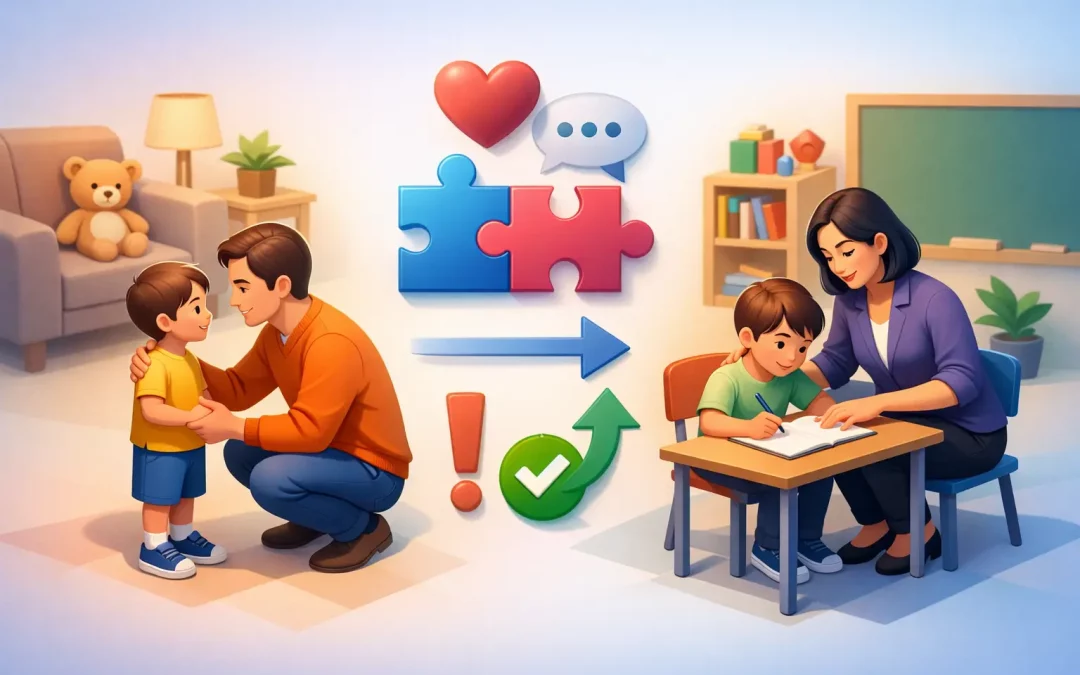
A child slams a door, shouts, refuses to move, or says something hurtful. Your mind may immediately go to the behavior: That cannot continue. You are not wrong to want a limit. Connection before correction examples help with what comes next: reaching the young person’s overwhelmed nervous system first, so they can actually hear the boundary, repair harm, and learn.
This is not permissive parenting or pretending difficult behavior is okay. It is choosing the order that works best when stress is high. A dysregulated child or teen is often not able to process a lecture, reason through consequences, or use skills they normally have. They need a steady adult before they can use their own steadiness.
Connection says, “I see that something is hard.” Correction says, “This behavior needs to change.” Both can be true. The difference is that connection creates enough safety for correction to land.
What connection before correction looks like
Connection does not have to be long, emotional, or perfect. In a hard moment, it may be a quiet voice, a few simple words, some physical space, or a glass of water placed nearby. It is the adult choice to notice what is underneath the behavior rather than treating the behavior as the whole story.
You might be seeing disappointment, fear, embarrassment, sensory overload, hunger, grief, a need for control, or a young person who has been holding it together all day. Understanding the reason does not erase responsibility. It gives you a more useful place to begin.
At Anchor Point, this can be held in four simple steps: Notice, Regulate, Respond, Repair. Notice what is happening in the child and in yourself. Regulate before reacting. Respond with connection and a clear limit. Repair when the storm has passed.
The goal is not to say the perfect thing. The goal is to avoid adding more heat to an already overloaded moment.
Connection before correction examples for real life
When a child refuses to leave the playground
Your child drops to the ground when it is time to leave. You feel eyes on you, dinner is waiting, and you have already given three warnings.
A correction-first response might sound like, “Get up now. If you do not listen, you will not come back here.” That may get movement, but it can also turn a hard transition into a power struggle.
Try connection first: “You were having so much fun, and stopping feels really hard. I get it.” Pause for a breath. Then add the limit: “It is still time to go. You can walk to the car, or I can help your body get there.”
You are not negotiating whether to leave. You are naming the hard feeling and holding the boundary. If they cry all the way to the car, the boundary still stands. Your calm presence is the support.
When a student throws work or rips a paper
A student crumples an assignment and throws it across the room after being corrected. The behavior needs attention, especially if others were affected. But public correction in the heat of shame can make the situation bigger.
Move closer if it is safe, lower your voice, and keep your words brief: “This feels like too much right now. I am going to help you reset.” Offer a simple next step: “You can take two minutes at the calm desk, or get a drink of water with me.”
Once the student is more settled, correct the behavior clearly: “It is okay to be frustrated. Throwing work is not okay because it can scare people and make a mess. Let’s figure out what you can do when the work feels impossible.”
Later, repair may include picking up the paper, checking in with anyone affected, and making a plan for the next difficult assignment. The student is still accountable. They are just not being asked to learn while their system is on fire.
When a teen yells, “I hate you”
Few things hit harder than a teenager shouting cruel words at you. It is natural to feel hurt and angry. You may want to return the energy with, “Do not talk to me that way.” The limit matters, but your first job is to keep yourself from joining the escalation.
Try: “I can hear how upset you are. I am not going to keep talking while we are yelling at each other.” Then give space without withdrawing the relationship: “I will be in the kitchen when you are ready to try again.”
Later, when things are calmer, come back to it. “You were really angry about me saying no. You are allowed to be angry. Calling me names is not okay. What could you say next time that tells me you are furious without trying to hurt me?”
This is not a free pass for disrespect. It is a lesson in how to carry a big feeling without damaging the relationship.
When a child hits a sibling
Safety comes first. Connection before correction does not mean waiting to intervene when someone could get hurt. Separate the children calmly and physically if needed.
Use few words: “I will not let you hit.” Attend first to the child who was hurt. Then, when the child who hit is calmer, connect with the feeling beneath the action: “You wanted that toy, and you got really mad when your brother took it.”
Then correct and teach: “Hitting hurts. Next time, move back, say ‘I am still using that,’ or come get me.” Help them repair in a way that fits their age and readiness. A forced apology while they are still furious rarely builds empathy. They may need time before they can offer a genuine apology, bring ice, help rebuild a block tower, or make a better plan.
When a young person shuts down after a mistake
Some behavior is loud. Some is silence, refusal, or hiding under a hood. A child who will not speak after getting in trouble may be overwhelmed by shame, not trying to manipulate you.
Instead of pushing for an immediate explanation, try: “You do not have to talk right now. I can see this is hard. We will figure it out together.” You might add, “I need you to stay nearby and be safe. We can talk in ten minutes or after dinner.”
When they are ready, keep the focus on the next right step. “The lie needs to be addressed, and I also want to understand what made telling the truth feel so hard.” Curiosity does not remove the consequence. It helps you choose a consequence that teaches rather than simply punishes.
What to say when you are angry too
Connection is hardest when your own nervous system is activated. You may be tired, embarrassed, worried, or carrying your own stress. Adults need tools, not shame, in these moments.
If you feel yourself getting sharp, use a short reset before you respond. Put both feet on the floor. Exhale longer than you inhale. Lower your voice. Say less. If the situation is safe, take a brief pause: “I am getting too upset to handle this well. I am going to take one minute and come back.”
You do not have to be perfectly calm to be helpful. You only need to be calm enough not to make the moment less safe. If you do react in a way you regret, repair matters. “I was frustrated, and I yelled. That was not okay. The limit still matters, and I want to try that conversation again more calmly.” This teaches accountability far more clearly than pretending adults never make mistakes.
Connection is not the same as giving in
Sometimes a child needs comfort and a firm no at the same time. “I know you want more screen time. It is disappointing to stop. The answer is still no.” Sometimes a student needs a break and still needs to complete the assignment later. Sometimes a teen needs space and still needs to repair a broken rule.
The trade-off is that connection can take a little more patience upfront. But correction without connection often creates repeat arguments, shutdowns, and resentment that take far more time later. The approach may look different depending on age, safety concerns, developmental needs, and the setting. A child in immediate danger needs fast, clear action. A child who is simply overloaded needs steadiness and fewer words.
When behavior is intense or repeating, do not ask only, “How do I stop this?” Also ask, “What is this young person showing me they cannot yet manage alone?” That question makes room for skill-building, support, and a plan.
The next hard moment will not require perfection from you. Notice the storm. Regulate your own body. Offer one point of connection, then hold the limit. Each time you do, you show a child or teen that hard feelings do not have to end in disconnection – and that change is possible inside a relationship that feels safe.
 English (United States)
  English (UK)