
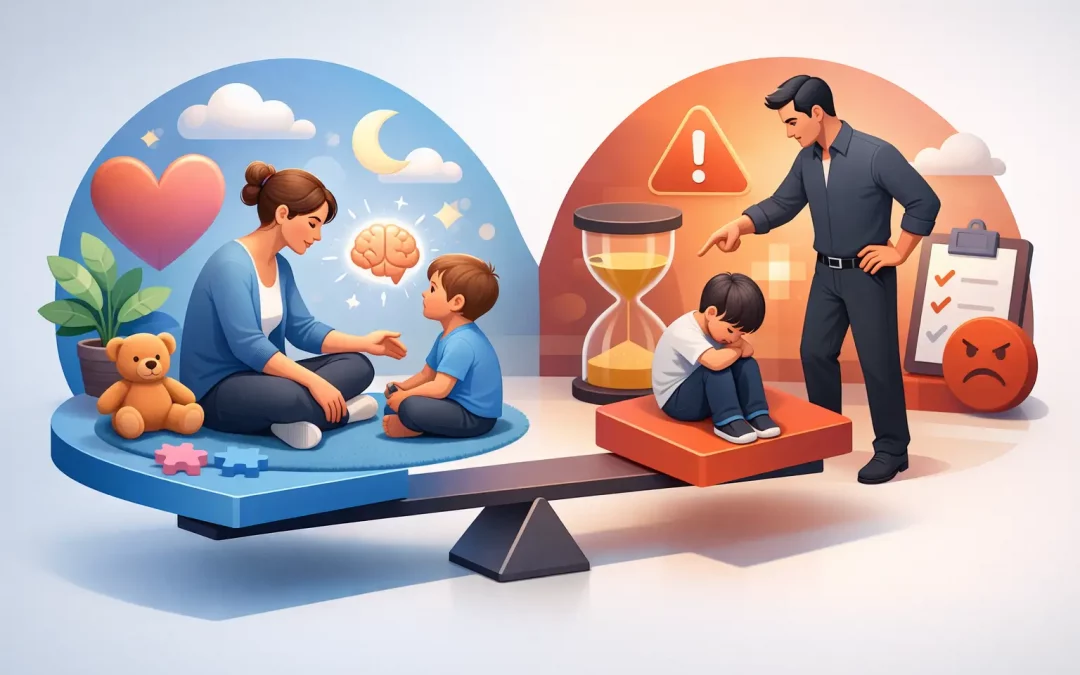
A child is yelling, refusing, throwing things, or shutting down completely. In that moment, the question of co regulation vs discipline can feel urgent: Do I comfort them, or do I hold the line?
The honest answer is that you may need both. But not in the order many of us were taught.
When a young person is overwhelmed, frightened, furious, or flooded with shame, their brain is not ready for a lecture, consequence, or debate. They need an adult who can bring steadiness to the moment first. That does not mean behavior gets ignored. It means you address the behavior in a way their nervous system can actually receive.
Co Regulation vs Discipline Is Not an Either-Or Choice
Co-regulation is the process of helping a child or teen settle through your calm presence, voice, boundaries, and support. It might sound like, “I can see this is really hard. I’m here. We are going to get through the next few minutes safely.”
Discipline, at its best, means teaching. It helps a young person learn what happened, what the limit is, how their actions affected others, and what they can do differently next time.
The problem is that discipline often gets confused with punishment. Punishment focuses on making a child uncomfortable enough that they will not repeat a behavior. Teaching focuses on building the skills that make a different choice more possible.
A child who hits when frustrated may need a firm limit: “I will not let you hit.” They may also need help with the skills underneath that behavior: noticing body signals, asking for space, handling disappointment, and repairing harm. A consequence alone cannot teach all of that.
Co-regulation is not letting a child run the show. It is not agreeing with hurtful behavior. It is the adult work of becoming steady enough to guide the moment instead of getting pulled into it.
Why Discipline During Dysregulation Often Backfires
When a child is dysregulated, their body is in protection mode. They may fight, flee, freeze, argue, lie, cry, go silent, or act as if they do not care. These responses can look intentional and disrespectful. Sometimes a child is testing a limit, too. But the behavior is still telling you something: their coping capacity is overwhelmed.
If we respond with raised voices, threats, long explanations, or immediate demands for remorse, the child’s alarm system often gets louder. The result is usually more escalation, not more learning.
This does not mean you have to accept unsafe behavior. Safety comes first. You can block a hit, move objects, create distance, call for support, or remove other children from the area. You can be clear and firm without becoming harsh.
Try language that is brief and grounded:
“Stop. I won’t let you throw that.”
“You are allowed to be mad. You are not allowed to hurt me.”
“We can talk when your body is safer.”
“I’m stepping back, but I’m staying nearby.”
The goal is not to say the perfect thing. The goal is to lower the temperature enough that thinking can return.
Notice What Is Happening Underneath
Behavior is communication, even when it is messy, loud, or hard to understand. A child who refuses school every morning may be anxious, exhausted, embarrassed, overwhelmed by a social problem, or trying to avoid work that feels impossible. A teen who snaps, “Leave me alone,” may be protecting themselves from feeling exposed or powerless.
You do not have to guess perfectly. Start by noticing patterns.
What happened right before the behavior? Was there a transition, correction, demand, disappointment, conflict, sensory overload, hunger, fatigue, or worry? What does the child’s body look like? Are they pacing, clenching, crying, getting loud, withdrawing, or becoming unusually silly?
These observations do not excuse harmful behavior. They give you useful information. When you understand the pressure building underneath, you can respond to the actual need instead of fighting only the surface behavior.
At Anchor Point, this can be held in four simple steps: Notice, Regulate, Respond, Repair. You do not need to do them perfectly. They offer a path when your own brain is getting overwhelmed, too.
Regulate Yourself Before You Try to Teach
This is often the hardest part, especially when you are tired, worried, or have been dealing with the same behavior for weeks. Your own nervous system matters because children borrow calm from the adults around them.
Before you respond, take one slower breath. Unclench your jaw. Lower your voice. Put both feet on the floor. Remind yourself: “This is hard, but I do not have to solve everything in this minute.”
That pause is not weakness. It is leadership.
If you are too activated to stay respectful, it is okay to get support or take a brief break when safety allows. A teacher might call a colleague. A parent might say, “I need two minutes to calm my body. I will come back.” Returning matters. It shows a child that hard feelings do not have to break connection.
Respond With Connection and a Clear Limit
After you have grounded yourself, offer the smallest amount of support the moment needs. Some children need quiet proximity. Others need space, a drink of water, a walk, a familiar routine, or fewer words.
Then state the boundary clearly. Connection without limits can feel confusing. Limits without connection can feel threatening. Together, they create safety.
For example, if a child refuses to leave the playground, you might say, “You do not want to go. Leaving is hard when you are having fun. It is time to get in the car. Do you want to walk beside me or hold my hand?”
If a teen slams a door and insults you, try, “You are really upset. I am not going to argue through the door. You can have space, and we will come back to the way you spoke to me later.”
Notice that neither response gives up the expectation. The adult stays calm, keeps the limit, and does not turn the moment into a contest of wills.
Teach and Repair After the Storm
The teaching part of discipline works best after the child is calm enough to think. This may be 10 minutes later, after school, or the next day. Timing matters more than speed.
Keep the conversation simple. Start with curiosity rather than accusation: “What was going on for you when you threw the backpack?” Then name the impact: “It scared your sister, and it damaged the wall.” Finally, work together on repair and a plan: “What needs to happen now? What can you try when you feel that angry again?”
Repair might include an apology, helping clean up, replacing something, practicing a different response, or reconnecting with the person who was hurt. It should be meaningful, not humiliating.
Natural and logical consequences can still have a place. If a child misuses a device, access may pause while you make a plan for safer use. If they damage something in anger, they may help fix or replace it. The difference is the purpose. The consequence should be connected to the behavior, proportionate, and aimed at learning, not payback.
When a Stronger Response Is Needed
Some situations require immediate, firm action. If a child is at risk of hurting themselves or someone else, destroying property, running away, or using substances, prioritize safety and bring in appropriate support. Co-regulation is not a substitute for a safety plan, school procedures, medical care, or professional help when those are needed.
Even then, the same principle holds: calm is more effective than chaos. Clear direction, reduced stimulation, and steady adult support help more than shame.
You will not always get this right. No parent, teacher, or caregiver stays regulated every time. What matters is what happens next. You can repair your own response, too: “I yelled, and that was not okay. I was overwhelmed. I am working on handling this differently. The limit still stands.”
That is not losing authority. It is teaching accountability in real time.
The next hard moment does not need a perfect adult. It needs a present one – someone willing to pause, see the distress beneath the behavior, hold the boundary, and come back for repair. Those small, steady moments build the safety and skills children carry with them long after the storm has passed.
 English (United States)
  English (UK)